
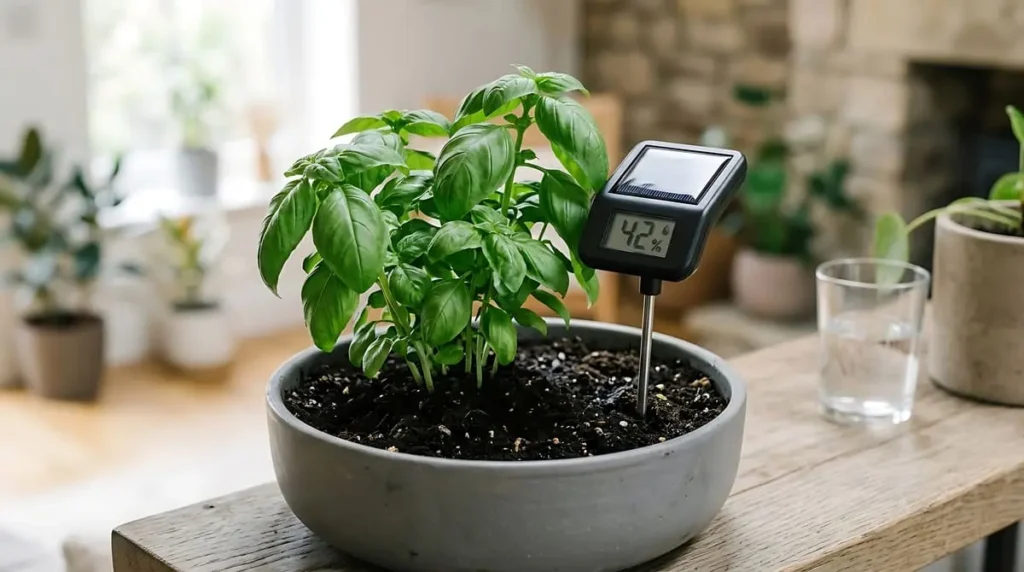
The best soil moisture meter for indoor plants for most people is the XLUX T10. It’s an analog probe costing between $10 and $13 that requires no batteries and within seconds lets you know whether the soil at root level is dry, moist or wet. For those who prefer leaving something inside the pot, the Sustee Aquameter changes color once the soil dries out. For those who wish to monitor the data on their mobile device, Ecowitt’s wireless kit is the most reliable option we found.
A meter will not water your plants, and cheap versions can play tricks on you if you do not know their peculiarities. Please find below our seven recommendations ranked from best to worst, along with an explanation of why some meters show “dry” in soaked soil, how to read the dial for different plants and three alternatives for checking soil without a meter.
Best Soil Moisture Meter for Indoor Plants: Quick Picks
Want the best soil moisture meter without reading further? Stop at number one. Here’s how all seven compare:
| Rank | Model | Rating | Price | Type | Best for |
|---|---|---|---|---|---|
| 1 | XLUX T10 | 4.6/5 | $10-$13 | Analog probe | Most houseplants |
| 2 | Ecowitt WH0291 | 4.5/5 | $25-$30 | Digital with screen | Exact readings and calibration |
| 3 | Sustee Aquameter | 4.4/5 | $6-$9 per stick | Leave-in color indicator | Plants you forget about |
| 4 | XLUX Long Probe | 4.3/5 | $12-$29 | Analog probe | Large floor pots |
| 5 | Ecowitt GW1206 Kit | 4.3/5 | About $49 | Wireless with app | Alerts on your phone |
| 6 | ThirdReality Gen2 | 4.1/5 | About $20 | Zigbee smart sensor | Smart home hubs |
| 7 | Luster Leaf Rapitest 1820 | 4.0/5 | $20-$27 | Analog with corded probe | Hanging baskets |
- XLUX T10: best overall
- Ecowitt WH0291: best digital readout
- Sustee Aquameter: best leave-in indicator
- XLUX Long Probe: best for large floor pots
- Ecowitt GW1206 Kit: best wireless setup
- ThirdReality Smart Soil Moisture Sensor Gen2: best for Zigbee smart homes
- Luster Leaf Rapitest 1820: best for hanging baskets
Prices checked November 2026 at major retailers and brand websites. Prices change often, so check before you buy.
How We Picked These
We didn’t run our own lab tests. To find the best moisture meter for plants, we evaluated manufacturer specifications, side-by-side comparison tests, a 45-day independent test of 10 smart soil sensors and owner reviews. We considered repeated complaints about stuck needles and connection loss especially important, since these problems only show up after weeks of use.
Every recommendation includes our Nest & Aura rating, a score out of 5 based on reading consistency (35%), user-friendliness (25%), durability/maintenance (20%) and cost-efficiency (20%). We judged every option as a soil moisture meter for indoor plants in real homes, with pots from 4 to 14 inches wide and ordinary potting mix.
Best Overall: XLUX T10
Nest & Aura rating: 4.6/5
The XLUX T10 is what most plant owners end up getting. It is a single stainless steel probe with a dial featuring 10 steps that are divided into dry, moist and wet zones. Insert the probe into the soil, give it a couple of seconds and take note of the needle reading. The good news about the XLUX T10 is that it requires no batteries or app, and in published comparison tests it showed good separation between dry, moist and saturated soil.
The single-probe design allows for less disturbance to the roots than the two-prong designs on cheaper models. The xlux soil moisture meter does have limits. In chunky, bark-heavy mixes, air pockets form around the probe, so press the soil around it or the reading will lean dry. And like every analog plant soil moisture meter, it shouldn’t live in the pot. Read it, pull it out and wipe it.
If you only buy one soil moisture meter for indoor plants, make it this one.
Typical price range: $10 to $13 at major retailers.
Best Digital Readout: Ecowitt WH0291
Nest & Aura rating: 4.5/5
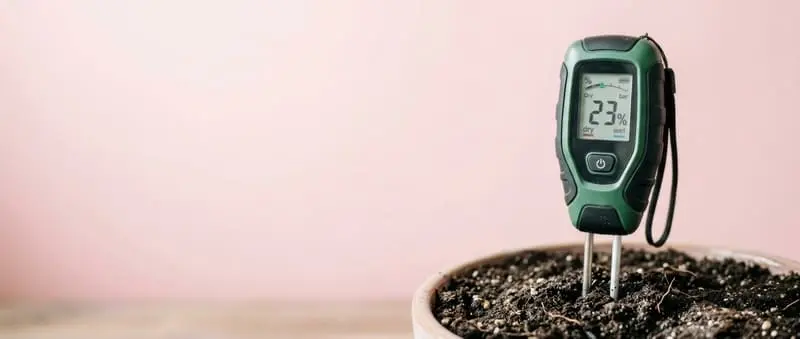
If the needle is driving you mad because it oscillates between 3 and 4, the Ecowitt WH0291 gives you the figure you want. What you get is Ecowitt’s WH51 sensor combined with a small LCD screen that displays soil moisture on a 0 to 100% scale. The sensor uses capacitive technology and is less affected by fertilizer salts than affordable analog sensors.
This digital soil moisture meter also lets you calibrate it. You set the 0% and 100% points for your potting mix, thus overcoming the primary shortcoming of any general-purpose dial. Drawbacks include readings that can take up to 72 seconds to stabilize, the need for AA batteries and a short probe that only reaches the top portion of large pots. One additional benefit that users overlook is that the WH51 sensor included in the pack can later communicate with an Ecowitt Wi-Fi gateway if you want app alerts.
Typical price range: $25 to $30 on the brand’s site and at major retailers.
Best Leave-In Soil Moisture Meter: Sustee Aquameter
Nest & Aura rating: 4.4/5
The Sustee is the simplest leave in soil moisture meter you can buy. The device is just a small plastic stick whose core absorbs the moisture present in the soil. Whenever there is adequate moisture in the soil, the window at the top becomes blue. As the soil dries, the window turns white, and that’s when you know it is time to water.
However, that’s where the strengths of the device end. It cannot determine the degree of moisture in the soil but simply indicates whether it is wet or dry. Plants that like steady moisture should be watered as soon as the blue in the window starts to fade. The response rate is also relatively slow: a medium stick requires about 15 minutes to turn blue after watering. The core lasts 6 to 9 months. Choose the device based on the pot size: a small stick for pots 2 to 3 inches wide, a medium stick for 3.5 to 6 inches and a large one for 6 to 12 inches.
If you’d rather put a plant water meter in every pot than probe each one, this is the one to get.
Typical price range: About $6 to $9 per stick, less in multi-packs. Refill cores come in pairs.
Best for Large Floor Pots: XLUX Long Probe
Nest & Aura rating: 4.3/5
Large floor plants trick fingertips and short probes alike. The upper 2 inches of a 14-inch pot may be completely dry even when the bottom half of the pot holds excess moisture, which is why fiddle-leaf figs and monsteras often suffer from root rot. The XLUX Long Probe (model T9178) takes the simple dial of the T10 and adds about 5.5 inches to its probe length. This lets you check the bottom third of the pot, where moisture gathers.
All the same analog guidelines apply: never leave it in the soil and clean it after each use. The fragile probe is susceptible to bending in tough soil, so use slow and gentle pressure. Make sure you test both halfway down and closer to the bottom. If the bottom reads wet but the top is dry, wait. If both read dry, water thoroughly.
Typical price range: $12 to $29, depending on sales.
Best Wireless Soil Moisture Meter: Ecowitt GW1206 Kit
Nest & Aura rating: 4.3/5
For readings on your phone, the Ecowitt GW1206 kit is the most dependable wireless soil moisture meter setup we found. You receive one WH51 sensor and the GW1200 Wi-Fi gateway, which sends data to the Ecowitt app, where you get historical charts and email notifications. The gateway supports up to 16 sensors, so you will pay only about $18 for each additional plant sensor instead of buying another kit.
It’s also the best smart plant sensor for Home Assistant users, since Ecowitt gateways work with it. Drawbacks associated with this technology are the ones common to most smart devices: the gateway has to remain powered and on Wi-Fi at all times, the sensor only detects the top few inches of soil and the batteries need replacing. You should set up your notifications to fire only when soil moisture has stayed low for several hours. Otherwise, a reading that hovers near your limit can ping your phone over and over.
Typical price range: About $49 for the kit. Extra WH51 sensors cost about $18 each.
Best for Zigbee Smart Homes: ThirdReality Smart Soil Moisture Sensor Gen2
Nest & Aura rating: 4.1/5
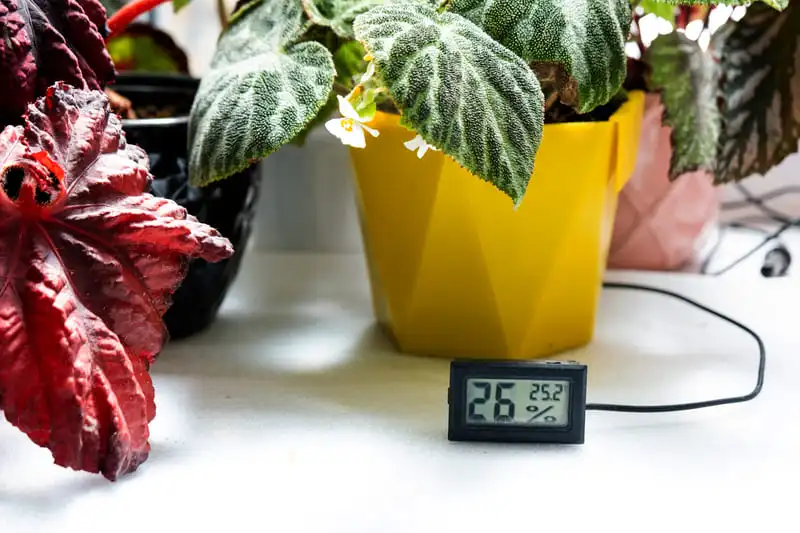
If your home already runs a Zigbee hub like SmartThings, Home Assistant, Hubitat or Homey, the ThirdReality Gen2 is the easiest plant moisture sensor to add. It is a capacitive sensor that runs off one AA battery and sends soil moisture information to your hub, so you can create alerts and integrate it into different automations. It went on sale in March 2026.
One problem is that its reading range is not ideal. Owners of the first model noticed that the readings only moved from about 50% when the soil was dry to 70% when it was wet, instead of using the full scale. Hence, do not take the exact number at face value. Observe it for two weeks and set your alert according to what it shows on the day your plant needs watering. That habit works for any budget smart plant sensor. It won’t connect to your phone without a Zigbee hub.
Typical price range: About $20 for one and about $57 for a 3-pack.
Best for Hanging Baskets: Luster Leaf Rapitest 1820
Nest & Aura rating: 4.0/5
The Rapitest 1820 puts its probe on a cord, so you can read a hanging basket or a pot on a high shelf without lifting it down. It’s a battery-free soil moisture meter for houseplants with a 1 to 10 scale and a guide to the watering needs of more than 150 plants. The guide works well when you’re not sure whether your plant needs dry spells between waterings.
The problem here is the depth. If the probe is not inserted deep enough, it will detect the drier top layer, and you’ll be misled into watering when you don’t need to. It must be inserted at least halfway down the pot.
Typical price range: $20 to $27 at major retailers.
Analog vs Digital vs Smart: Which Plant Moisture Sensor Fits You?
Before you pick a soil moisture meter for indoor plants, decide how hands-on you want to be. Every plant moisture sensor falls into one of four groups:
| Type | How it reads | Power | Can it stay in the soil? | Typical price | Best for |
|---|---|---|---|---|---|
| Analog probe (XLUX, Luster Leaf) | Electric current through the soil | None | No | 10-27 | Quick checks on many pots |
| Leave-in indicator (Sustee) | Core changes color as it gets wet | None | Yes, 6-9 months per core | 6-9 per stick | Set-and-forget pots |
| Digital meter (Ecowitt WH0291) | Capacitive sensor, number on a screen | AA batteries | Yes | 25-30 | Exact numbers and calibration |
| Smart sensor (Ecowitt GW1206, ThirdReality) | Capacitive sensor, readings sent to an app or hub | AA batteries | Yes | 20-49 | Alerts, history and automation |
There are two main types of soil moisture sensors: resistive and capacitive. Analog probes are resistive. They measure electrical resistance to estimate soil moisture, since moisture makes the soil conduct more readily. The problem with these sensors is that fertilizers and high mineral content in tap water also increase conductivity, making a fertilized pot seem wetter than it really is.
Capacitive probes, on the other hand, measure how the soil changes an electric field. They are affected by salts to a lesser extent, but they still read differently depending on soil type, which is why the better ones let you calibrate them. A digital soil moisture meter with calibration is the most precise way to check one plant at a time. For a wireless soil moisture meter, the radio matters too. Bluetooth talks straight to your phone but only over a short distance, Zigbee needs a hub and Ecowitt uses its own radio plus a Wi-Fi gateway.
Do Plant Moisture Meters Actually Work?
Yes, as a guide. A plant moisture meter is good at telling you whether the soil at root level is dry, moist or wet, which is the question that matters before you water. It’s less good at exact numbers. Clemson Cooperative Extension notes that these meters vary widely in accuracy and that readings can be influenced by factors other than soil moisture. Most bad experiences come down to one of these:
- A stuck needle. If a cheap moisture meter for plants reads dry in soil you just soaked, tap it firmly against your palm until the needle moves freely. If it still won’t budge, return it.
- Shallow testing. The top inch dries first; therefore, drive the probe at least halfway down the pot.
- Air pockets. Chunky, large-particle mixes create air pockets near the probe; therefore, gently compress the mix around the probe.
- Salt accumulation. Fertilizer and hard water increase readings. Periodically water the pot until it drains freely through the drainage holes. According to Clemson, this washes out excess salts.
- Wrong test. Do not test a meter in a glass of water; allow a newly watered pot to drain before testing.
For the first two weeks, check any new soil moisture meter for indoor plants against one of the free methods below. Overwatering is cited by Clemson as the leading cause of death for potted plants, so if the meter reading conflicts with what you feel with your fingers, give it a day. Little flies hovering above the pot are also indicators of overly moist soil. Here’s our guide to dealing with flying bugs on indoor plants.
How to Use a Soil Moisture Meter (and Read It)
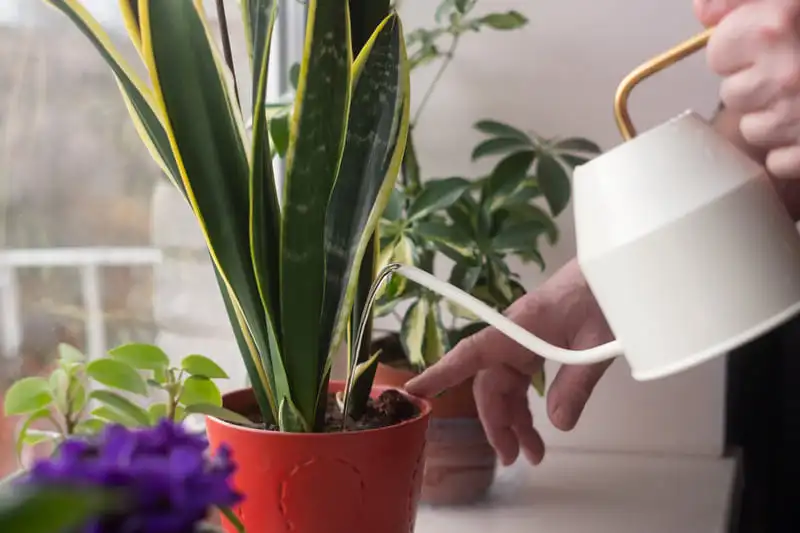
Every moisture meter for plants works best with the same routine:
- Drive the moisture meter probe in midway between the stem and the rim, about halfway down the pot (deeper in large pots).
- Wait for the needle or the number on the display to stabilize. Analog meters stabilize almost instantly, while some digital sensors need a minute or more.
- Get a second reading from the opposite side of the pot, because water content can be uneven.
- Withdraw the probe, clean it and store it dry.
Then check your reading against the preferences of your plant. Here is when to water on a scale from 1 to 10, with 10 being saturated. Treat these numbers as a starting point:
| Plant type | Examples | Water when the reading drops to |
|---|---|---|
| Cacti and succulents | Echeveria, jade, aloe, snake plant, ZZ plant | 1-2 |
| Most foliage plants | Pothos, monstera, philodendron, dracaena | 3-4 |
| Moisture lovers | Ferns, calatheas, peace lily, fittonia | 4-5 |
Right after a thorough watering, most meters should read 8 to 10. If yours doesn’t, the water probably ran down the sides of a dry root ball, so water again slowly. Used this way, a soil moisture meter for indoor plants turns watering into a habit instead of a guess. If leaves keep yellowing while the meter reads wet, our guide to monstera leaves turning yellow covers the signs of overwatering.
No Meter? 3 Free Ways to Check Soil Moisture
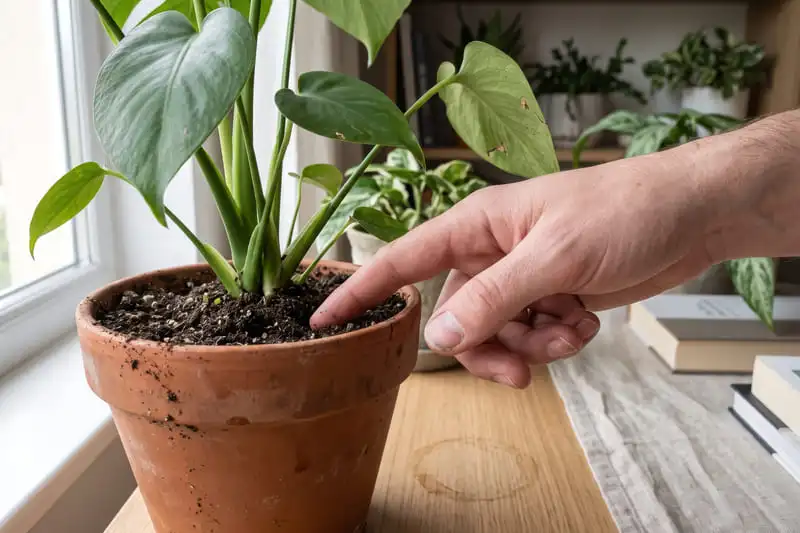
Before you buy a plant water meter, try these. They’re also the best way to double-check one.
- Finger test. UConn Extension recommends feeling the soil about one inch deep rather than watering according to a calendar. This is fast, but it will only tell you about the top of the pot.
- Chopstick test. Use an uncoated wooden chopstick or skewer to test how much water is left in your plant’s pot. Push it to the bottom of the pot, leave it for about a minute and pull it out. Wet soil on it means wait, and you will often notice a dark line where the moisture starts.
- Lift test. Lifting the pot right after watering and then again when it’s dry will show you the difference in weight. Clemson mentions that potting soil loses a significant amount of weight as it dries. For accurate measurements, use a kitchen scale. If a pot weighs 4.5 lbs dry and 6.5 lbs right after watering, the closer it gets to 4.5 lbs, the closer it is to needing water.
Best Garden Soil Moisture Meter for Outdoor Beds
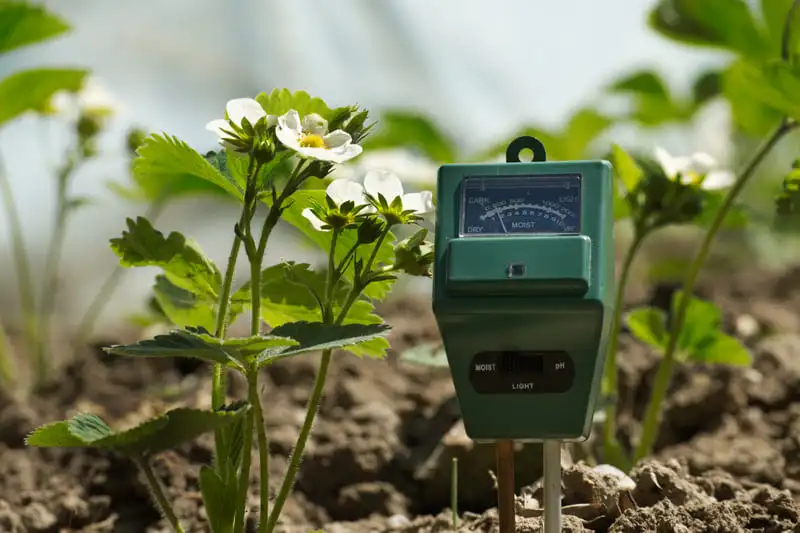
Outdoor beds need a sturdier probe than houseplants do. The best garden soil moisture meter for beds and compost piles is the REOTEMP Garden and Compost Moisture Meter, at about $50. Its long, thick probe goes into firm soil without bending, and the dial is easy to read standing up.
To monitor deep raised beds through your smartphone, try the WH51L by Ecowitt ($49.99). It comes with a 1-meter wire attached to its sensor and uses the same gateway as the indoor monitoring set. If you use automated watering, combining a sensor with one of the smart sprinkler controllers we’ve reviewed will help you avoid unnecessary watering.
What to Know Before Buying
Match Probe Length to Pot Depth
When you shop for a soil moisture meter for houseplants, check probe length first. The probe should reach the middle of the root ball. Short probes suit small pots and hanging baskets, while pots deeper than about 10 inches need a long one.
Skip the pH Extras
There are many inexpensive testers that give 3-in-1 or 4-in-1 results. The moisture function typically works well. The pH function usually does not; in one 2026 comparison test, the pH needle on a popular 3-in-1 tester showed minimal movement. You should use a separate soil test to check pH. Here is our guide to testing garden soil at home.
Calibrate Before You Trust It
Test a new plant moisture meter in a pot you know is bone dry and in one you watered an hour ago. The gap between those two readings is your real range. Ecowitt sensors let you save those points. With an analog plant soil moisture meter, just write them down.
Count the Hub in the Price
A smart plant sensor is only as good as its connection. Zigbee sensors require a Zigbee hub, while Ecowitt requires a Wi-Fi gateway, so if you do not have one yet, include it in the price of the sensor. Also, use decent batteries, since poor ones will not last long.
Don’t Leave Analog Probes in the Soil
Battery-free analog probes will corrode in wet soil, and corroded probes tend to drift. Read them, take them out, clean them and store them dry. If you would like something that stays in the pot, get a leave-in indicator or a sealed smart sensor. The best soil moisture meter is the one you’ll actually use, so pick the type that fits your routine.
What to Expect in 2027
The following is our prediction, not a guarantee made by any brand. The most significant development is the Matter protocol, the smart home standard that spans Apple Home, Google Home, Alexa and SmartThings. Matter 1.5, released on November 20, 2025, includes an official soil sensor device type that reports moisture and, optionally, temperature. We expect Matter soil sensors to show up widely in 2027, so one plant moisture sensor could work with whichever smart home app you use.
We also expect capacitive sensors to keep getting cheaper, since Zigbee models already sell for about $20. Analog probes like the xlux soil moisture meter will stay the budget choice.
Our advice: if you only need to know when to water, buy an analog meter now. If you want alerts and don’t run a hub yet, wait a few months to see which Matter sensors arrive. Either way, a soil moisture meter for indoor plants you check every week beats a smart one you ignore.
FAQ
Not an analog probe. Metal probes corrode in damp soil, and that throws off the readings. Products built to stay in the pot are fine, like the Sustee (a true leave in soil moisture meter) and sealed smart sensors such as the Ecowitt WH51 and ThirdReality Gen2.
Which moisture meter is most accurate?
Capacitive sensors you can calibrate, like the Ecowitt WH51, gave the most consistent readings in independent testing. For deciding when to water, though, a good analog soil moisture meter for indoor plants is accurate enough. That’s why the XLUX T10 is still our pick for the best moisture meter for plants overall.
How can I make a DIY plant moisture sensor?
The components you need are an ESP32 board, a capacitive soil probe and a battery, with the measurements relayed to Home Assistant. The exposed edges of the probe’s circuit board have to be sealed with conformal coating or epoxy, because moisture will eventually corrode them. Calibration should be done in dry and recently watered potting soil, not in air and a glass of water.
What moisture level should indoor plants be at?
It all depends on the type of plant. On a scale of 1 to 10, cacti and succulents can drop as low as 1 or 2 before watering, most foliage plants can drop to 3 or 4, while moisture-loving ferns and calatheas should only drop to 4 or 5. A soil moisture meter for indoor plants makes these numbers easy to track.
Final Thoughts
An expensive device is not required to prevent overwatering. A simple analog probe costs about $10, and if you use it to measure soil moisture halfway down the pot and clean the probe after every measurement, you will solve the problem in most households. Use the Sustee for the plants you tend to forget. Whichever soil moisture meter for indoor plants you choose, check it against your finger or the lift test for the first couple of weeks.
If you grow food crops, the very same techniques will help keep an indoor herb garden with grow lights or even an entire indoor vegetable garden healthy. Collecting more plants? These hard-to-kill plants won’t mind if a reading gets missed occasionally.