
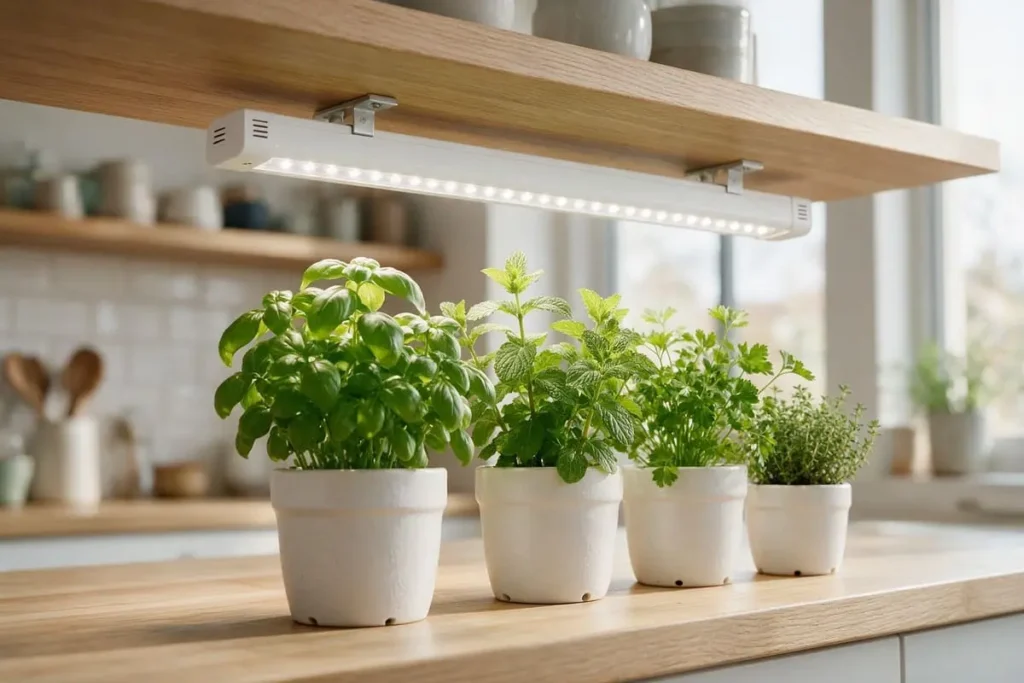
An indoor herb garden with grow lights lets you grow fresh herbs even when your windows don’t get enough sun. Start with a white full-spectrum LED and a consistent daily timer, then adjust the light’s position as your herbs grow. Here’s how to set up your garden and spot signs that the lighting needs changing.
While they can survive, they won’t thrive, and that’s when problems arise, like sluggish root development, pale foliage, and a sharp drop in aromatic essential oil production. That said, let’s take a look at how to start an indoor herb garden with grow lights.
How Many Hours a Day Should a Grow Light Run for Herbs?
Generally speaking, 10 to 14 hours a day will do. Artificial light isn’t as effective and intense as natural light. In natural sunlight, most herbs will do with six to eight hours of direct sunlight. Since you’ll use grow lights, you’ll need to increase that amount to at least 10 hours a day.
The best way to create the perfect environment is to get grow lights with timers. You can set a timer for the required period of time. Also, to keep costs low, you may want to invest in efficient grow lights specifically modern energy-saving LEDs that add only pennies a month to your electric bill.
Signs Your Herbs Are Getting Too Little Light
While there’s a general requirement for herbs to get 10 to 14 hours of artificial light daily, the truth is that what works for some herbs won’t work for all of them. This means that you’ll need to adjust. There are a few signs to look for, which can indicate that your herbs aren’t getting enough light.
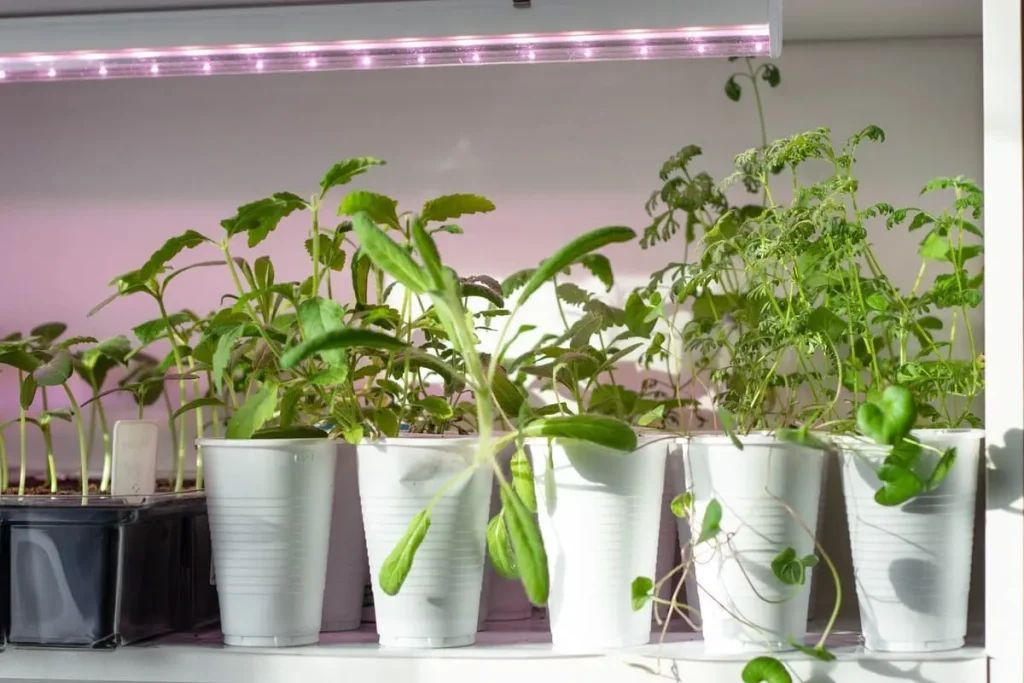
First, pay attention to their appearance. If they look weak or leggy, they’re not getting enough light. Second, take a look at their growth too. When the growth is stretched out towards the light source, this means that they don’t have enough of it.
This usually happens when the grow light isn’t strong enough or is too far from the plant. Leggy growth can be a clue that a spot is too dim. Our guide to the best indoor plants for low light explains how other indoor plants respond to limited light.
It’s worth noting that cheap clip-on lights aren’t always strong enough, even if they’re close to plants. That’s why you need to invest in professional alternatives.
Signs Your Herbs Are Getting Too Much Light
Based on the above-mentioned requirements, you may believe that more is better. Not really. In fact, too much light can be just as harmful for your indoor herb garden. Again, there are a few signs to pay attention to before making any adjustments.
If your seedlings germinate, but stall out with no real leaves growing, chances are you’re giving them too much light. On the same note, leaves that show discoloration are usually stressed by too much light.
The light could be too close in this case. Also, you’re probably getting too much of it for a small setup, so adjust accordingly.
Indeed, it could be a problem with the soil or water too, but before making assumptions, make sure to move the grow lights a few inches back about 6 to 12 inches above the canopy.
What Kind of Light Do Herbs Actually Need?
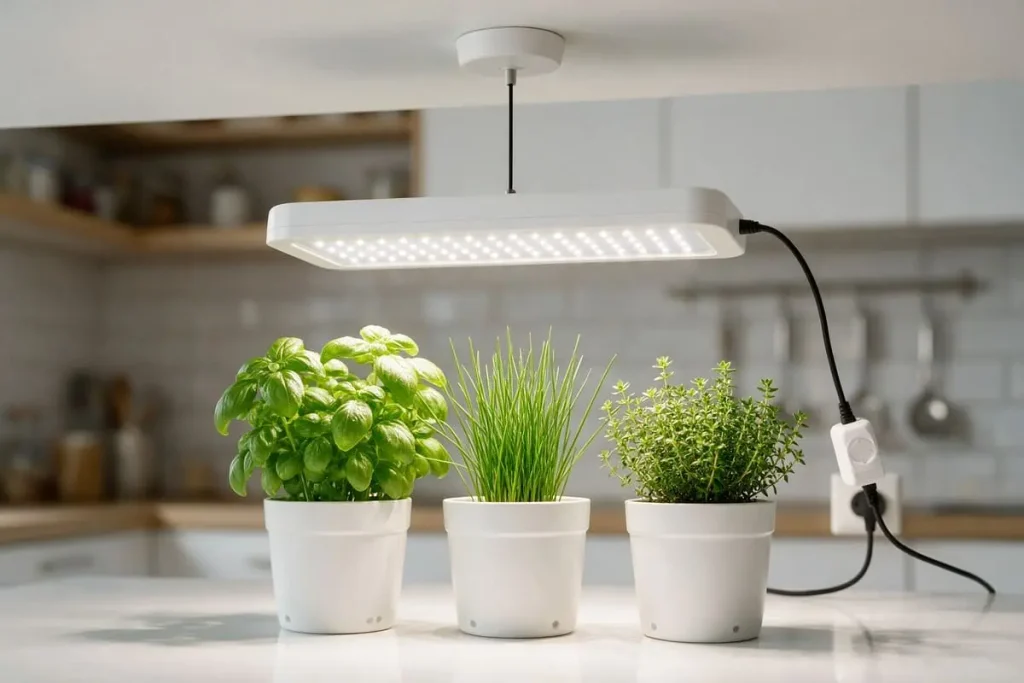
Cheap grow lights from any store are likely to provide basic light that has nothing to do with your herb garden. Instead of going for random stuff, opt for full-spectrum LED light, which replicates natural light. It looks like classic white light typically rated around 4000K to 6500K for crisp, clear visual brightness.
On the other hand, colored lights like pink or purple lights, are mainly aimed at flowering crops. They’re not as efficient for herbs. Besides, they look unnatural in the environment, so they could give you a headache.
Instead of all these, go for full-spectrum LED light, which has both red and blue wavelengths. Plants normally absorb these wavelengths, so you’re covered.
How to Set Up a Grow Light That Doesn’t Look Like a Science Experiment
When setting up an indoor herb garden with grow lights, most people look at the horticultural aspect only. Styling is just as important though. Imagine being in a kitchen with pink or purple light everywhere.
To cover both aspects, the full-spectrum fixture will sort everything out. It’s suitable for plants, but it also looks like natural light.
Talking about style and design, the light should be similar to other kitchen hardware, which isn’t difficult to match. Then, your herb station should be set as a nice feature. Whether it’s on a windowsill or a countertop, it should be an attractive feature, so don’t bother hiding it in a cabinet or closet. The same ideas for grouping pots and planning around available light can help elsewhere in your home; see our guide to arranging indoor plants in a living room.
Which Herbs Are Easiest to Grow Under Grow Lights?
If this is your first indoor herb garden, you may want to start with some light and easy herbs. Get some experience before moving on to different plants with different requirements.
As a general rule of thumb, mint, parsley and rosemary are known for accepting less light, along with hardy chives and fresh thyme. They’re easy to adjust to too. Besides, signs of too little or too much light aren’t that obvious, which is basically a good sign.
On the other hand, basil isn’t that forgiving. Compared to most other traditional herbs, it’s the most demanding one. It takes more light than others. It also shows stress as soon as you do something wrong, so you may need to make adjustments more often.
Common Mistakes to Avoid
Learning from others’ mistakes is highly recommended when starting your own indoor herb garden with grow lights. Here are some of the most common issues among newbies.
- No timer. This means that your herbs get inconsistent light. You’re wrong if you think that you can turn the lights on and off at the right time. At some point, you’ll become inconsistent, or you won’t be home at the right time.
- Lights too far or too close. These are other common issues, which are understandable if you’ve never had your own herb garden. Pay attention to potential signs of too much or too little light, then adjust accordingly.
- Assumptions. Some people assume that less light means less water too. Wrong. Soil exposed to grow lights will still dry out. Therefore, you have to follow the general watering requirements for your herbs. Keep checking the soil before watering: persistently damp pots can attract flying bugs on indoor plants, including fungus gnats.
FAQs
Absolutely, assuming that you match their light requirements. Grow lights are often more effective than windowsill locations.
What are the drawbacks of using grow lights for indoor plants?
Grow lights cost more than natural light, obviously. Besides, you could make mistakes when trying to figure out the perfect intensity or distance, but they can normally be fixed once you dial in your fixture height and leave the schedule to an automatic timer.
What is the easiest herb to grow indoors?
Mint is an excellent starting point. It does well in low light, but it’s also difficult to kill if you’re not experienced enough.
What is the most difficult herb to grow indoors?
Don’t start your first indoor herb garden with grow lights with basil, as it requires consistency and intensity. It’s a demanding plant, so get a bit of experience before moving on to it.