
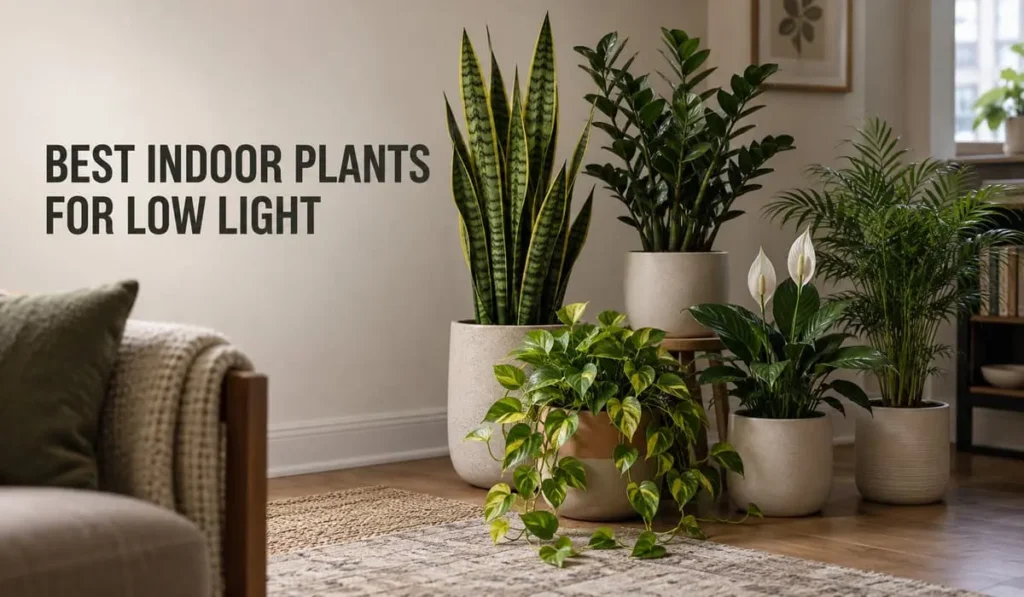
Finding the best indoor plants for low light should be a priority for certain parts of your home or office. Whether your apartment faces north or your hallway doesn’t get much natural light, you still have a few good options to bring some vibrant greenery indoors. It could even be a dark corner of your bedroom or perhaps your bathroom.
Now, while most plants can survive in low-light conditions (especially when there’s also a bit of natural light involved during the day too), the truth is that you need plants that will thrive. You need a real performer in low-light conditions, rather than a survivor.
This being said, let’s take a look at some of the best plants for poor lighting conditions, as well as popular plants that you can find pretty much everywhere. Don’t worry, this isn’t about rare names or exotic plants that no one’s ever heard of, but plants that you can find locally as well at your neighborhood garden center or nearby nursery.
What Actually Counts as Low Light?
Normally, low light can be defined as when you have to turn on a lamp in order to read a book. You can also run the hand test. If you can cast a shadow anywhere in the room at any time of day, you don’t have low light. Otherwise, you do.
Besides, keep in mind that low light doesn’t mean no light. The more light these plants get, the better they’ll be in terms of producing dense foliage and strong roots.
Do Low Light Plants Actually Thrive, or Just Survive?
Low light indoor plants tend to survive in such conditions. They tolerate these conditions and do well, so they keep growing. However, they don’t love these conditions. Once again, they’d do much better if they had more indirect light. If you can leave some doors open around them for more indirect light, do so.
Signs Your Plant Isn’t Getting Enough Light
Houseplants tend to show when they’re not doing well. If your plant isn’t getting enough light, there will be signs that manifest across its leaves and stems over time.
- Big gaps between leaves. Give the plant more light to fix it.
- Fading or reverting variegation. Cut the green stems back to a node that’s still colorful to fix it.
- Yellowing lower leaves. Identify the cause before deciding on the solution, such as aging, nitrogen shortage or overwatering.
- Stalled growth. Identify the cause first, such as root crowding, poor watering or insufficient light.
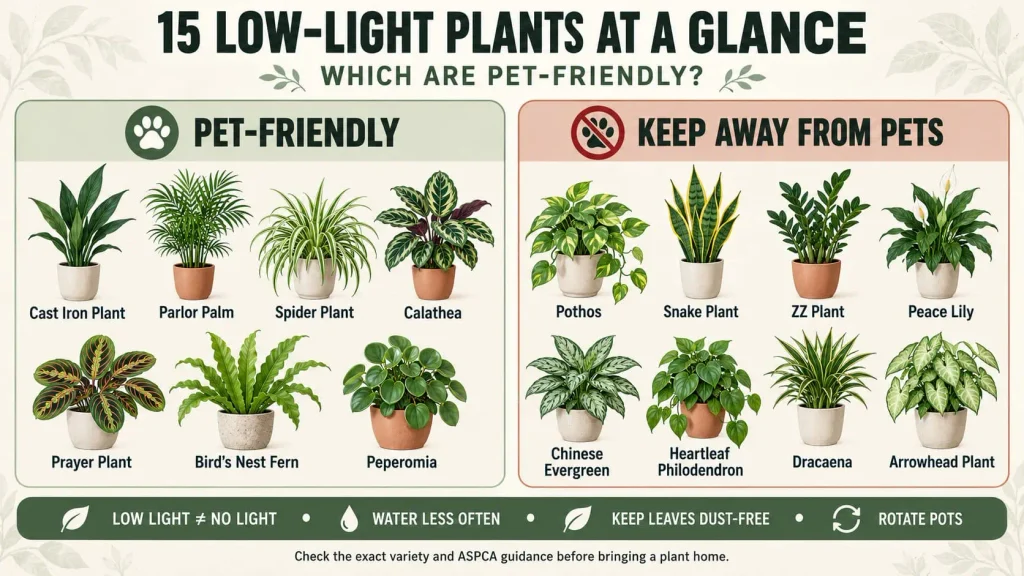
15 Best Indoor Plants for Low Light Rooms
Here are some of the perfect indoor plants for low light to consider for your home or office space if you want long-lasting greenery without demanding care. Several of these also rank among the hardest indoor plants to kill, so they’re a safe bet even if you’ve killed a few houseplants before.
1. Pothos
Pothos (Epipremnum aureum) thrives in low and medium indirect light. Variegated versions will need a bit of extra light, since they don’t have as much chlorophyll or pigmentation. In fact, this applies to all plants that display pale or patterned foliage indoors.
When light is minimal, watering also requires the top inch of soil to feel completely dry before watering. Pothos is toxic to both dogs and cats.
2. Snake Plant
The snake plant (Dracaena trifasciata) is hardy and doesn’t require much maintenance. It’s an evergreen option known for its upright leaves.
The snake plant can do with around eight hours of indirect sunlight a day. During summer, water it every three weeks. During winter, water it monthly. If you have pets, keep it out of range because it’s toxic to both dogs and cats.
3. ZZ Plant
The ZZ plant (Zamioculcas zamiifolia) is just as tough. It has beautiful, glossy leaves, but it can also survive in neglected conditions.
The ZZ plant thrives in bright light, but tolerates low light. It stores water, so it can survive in drought conditions. Also, it’s toxic to pets.
4. Peace Lily
The peace lily (Spathiphyllum) is one of the most popular low-light indoor plants. It has glossy leaves and elegant, white flowers that rise up like graceful flags.
The peace lily tolerates low light conditions and scorches in direct sunlight. It requires regular watering whenever the leaves start to droop slightly and is toxic to pets.
5. Cast Iron Plant
The cast iron plant (Aspidistra elatior) is better known for surviving regular neglect, irregular watering and, of course, low light levels. It’s an evergreen plant with a self-explanatory name.
The cast iron plant hates direct sunlight and requires watering only when the top half of the soil is completely dry. It’s not toxic to pets.
6. Chinese Evergreen
The Chinese (Aglaonema) evergreen draws instant attention with its patterned leaves. Its variegated variety requires more light than the classic alternative to keep those vivid colors from dulling.
The Chinese evergreen doesn’t need direct sunlight. As for watering, allow the top inch of soil to dry out before watering. The plant is toxic to dogs, pets and horses.
7. Heartleaf Philodendron
Heartleaf philodendron (Philodendron hederaceum) is popular because it’s easy to look after. It’s a trailing plant, so be careful when keeping it indoors.
It’s one of the indoor plants that tolerate low light and only require watering every one or two weeks. Keep it away from pets, as it’s toxic.
8. Parlor Palm
The parlor palm (Chamaedorea elegans) looks good, but also grows very slowly over several years indoors. It’s graceful and looks exotic due to its South American origins.
Only water it when the top inch of soil is dry. The plant is safe for pets too.
9. Spider Plant
The spider plant (Chlorophytum comosum) is a tough choice and one of the best indoor plants for low light settings like bedrooms or home offices. It has long, arching leaves, as well as spider offshoots.
The spider plant tolerates low light and hates direct sunlight. Water it when the top inch of soil is dry. It’s safe for pets.
10. Dracaena
Dracaena is one of those houseplants that can live both indoors and outdoors. The corn plant (Fragrans) is the most popular variety thanks to its woody stem and fountain-like foliage.
Direct sun burns its leaves, so keep it away from direct sun. Water when the top inch of soil feels dry. It’s toxic for pets, so keep it away.
11. Calathea
Calathea looks amazing due to its exotic profile. Patterned leaves make it stand out in the crowd like living artwork.
It requires indirect light and moist soil at all times. It’s not toxic to pets.
12. Prayer Plant
The prayer plant (Maranta leuconeura) has a self-explanatory name. Leaves lie flat during the day and go upward at night.
The prayer plant thrives in indirect light, needs evenly moist soil and isn’t toxic to pets.
13. Bird’s Nest Fern
The bird’s nest fern (Asplenium nidus) is tropical and exotic. Leaves form a nest-like element in the middle.
The bird’s nest fern does well with medium indirect light, needs water around the base, not the center, and isn’t toxic to pets.
14. Arrowhead Plant
The arrowhead plant (Syngonium) is a common, tropical vine. Leaves change their shape as the plant matures.
The arrowhead plant does well with indirect sunlight. It requires watering when the top layer is dry. Keep it away from pets because the sap can irritate their mouths.
15. Peperomia
Peperomia is one of the best indoor plants for low light if you like tropical perennials. It has beautiful, ornamental foliage.
Peperomia does well with low or medium light and water. It’s not toxic to pets.
Plants People Recommend for Low Light That Actually Aren’t
Ficus benjamina is often advertised to be a low-light plant, but it actually requires bright light, whether indirect or direct. Even some stores may mislabel it.
Best Low Light Plants by Room
The above-mentioned houseplants work well in rooms with low lighting conditions, whether a bedroom, office or bathroom. They still require some form of light though. If you want to decorate your basement, you’ll need a grow light, or your plants won’t survive for more than a few short weeks. If you’re arranging plants in a living room, group two or three low-light picks near a window with indirect light instead of scattering single pots around the room.
Which of These Are Safe for Pets?
Some low-light plants can be safe for all pets. Others are unsafe for certain pets. The above-mentioned list is mainly safe, but you should still check if you get a different variety. Use a pet safe plant finder tool to keep it safe and double-check ASPCA guidelines for complete clarity. Some plants can even be toxic to people, especially children.
Care Tips for Low Light Plants
Here are a few useful tips and tricks to keep your plants thriving.
- Soil stays wet longer in low-light conditions, so you may want to water less. Keep an eye out for flying bugs on indoor plants too – overwatering in low light is one of the most common causes.
- Keep leaves clean and dust-free for efficient light absorption.
- Rotate the pot every few days for all sides to get light.
- Heavy fertilizing isn’t a good idea in low-light conditions.
FAQs
They survive, rather than thrive.
A grow light gives you extra flexibility, so it’s definitely a good idea if you want to expand your plant choices to more light-hungry varieties.
No, although it’s often advertised to be, as it frequently sheds leaves when kept in dim corners.
Yes, as they have less chlorophyll.
Signs like long gaps between leaves are the best ways to tell, alongside pale foliage and stretched, leggy stems.
Try the hand shadow test mentioned above to determine lighting conditions.
Any of the above-mentioned plants will do well in low light.
Yes, but only with grow lights.
Use a pet finder tool to identify nontoxic plants that can do well with low light.
They require less water than other plants, but each plant has its own requirements.