
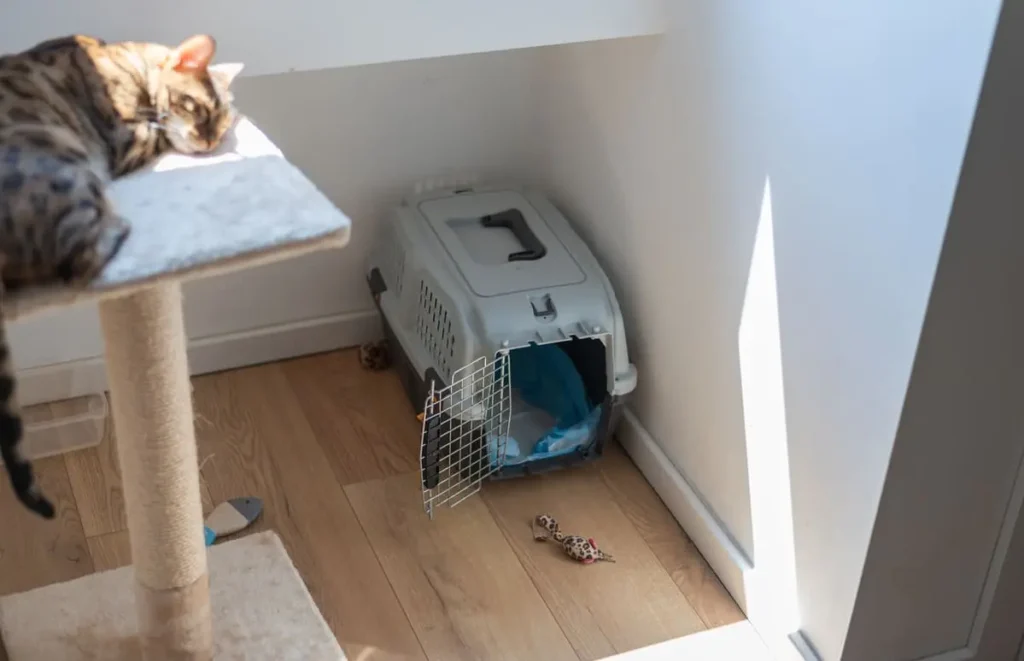
A safe room for cats is one small, quiet room with a door where a new cat spends its first days in your home, with food, water, a litter box, a bed and a place to hide all within a few steps. Keep the cat there until it’s eating, grooming, using the box, coming over to you and showing real curiosity about the door. For a confident adult that’s your only pet, that can take a few hours to three days. A shy cat can need weeks. If you already have a cat, plan on about two weeks and a vet check before the two ever meet face to face.
No shelter sets a fixed number of days, and they’re right not to. Their advice does sort neatly by situation, though.
How long to keep new cat in one room, by situation:
| Situation | Typical time in the safe room |
|---|---|
| Confident adult, only pet | A few hours to about 3 days |
| Typical adult cat | A few days to about 2 weeks |
| Kitten | A home base for the first few weeks |
| Shy, fearful or former stray | A week to several weeks, sometimes months |
| Other cats or a dog at home | About 2 weeks and a vet exam before they meet, then a gradual introduction |
What a Safe Room for Cats Actually Does
Give a nervous cat a whole new house and it will often vanish behind the washer or inside a box spring, where you can’t even check that it’s eating.
A safe room for cats shrinks the world to a size the cat can handle. It learns where the litter box is and works out that you bring food and nothing bad happens. If you have other pets, the room also keeps the newcomer apart until a vet has checked it. And once the cat moves out into the house, keep the room set up. It becomes the place your cat goes when the vacuum comes out or guests arrive.
Picking the Right Room
Shelters agree on the kind of room and argue about which one. San Diego Humane Society says a bathroom or a small bedroom with a door is ideal. Adopt-a-Pet’s guide leans toward the bathroom because there are fewer places to wedge into, while Toronto Humane Society prefers the bedroom because it’s quiet. Both work. The best safe room for cats has:
- A solid door that closes. A baby gate, glass door or screen door doesn’t count yet.
- Low traffic and little noise, so not the kitchen, a hallway or a laundry room with machines running.
- No hiding holes you can’t reach. In a bedroom, block the space under the bed.
- In a multi-cat home, a room your other cat doesn’t use much.
If your only bathroom is the one everybody uses all day, pick a bedroom instead.
No spare room at all? A quiet corner with a covered hiding spot, with the litter box and food nearby, can work for a confident cat in a home with no other pets. International Cat Care says a confident adult that’s the only pet may not need to be shut in at all. For a shy cat, or a home with other animals, a door matters.
How to Set Up a Cat Safe Room
Setting up a safe room for new cat arrivals takes about an hour and very little money. Here’s what goes in a cat safe room and where each thing should sit.
| Item | Where it goes | Why it matters |
|---|---|---|
| Hiding spot (the open carrier, a box on its side lined with fleece or a covered bed) | The corner furthest from the door | Toronto Humane calls hiding places “absolutely essential,” and you can still reach a cat in a hide you provided |
| Bed | Next to the hiding spot | A soft, quiet place to rest |
| Food and water | Near the bed, a few feet apart from each other | A calm place to eat, close to where the cat feels safe |
| Litter box | Across the room from food and water, away from the door | Cats don’t want to eat next to their toilet |
| Scratching post | Near the door | Tall enough for a full stretch, and scratching there marks the edge of its new territory |
| Perch or small cat tree | Two to three feet high, by a window | Lets the cat look down on the room and watch outside |
| Toys | Around the room | Pick ones that are safe unsupervised, so no strings or elastic |
| Something familiar | In the bed or hide | A towel from the shelter, plus the same litter and food it had before for the first week or two |
The perch height comes from Ohio State’s Indoor Pet Initiative, which also suggests leaving a radio on low while the cat is alone. If something outside the window scares your cat, cover the view for now.
Cat-Proof the Room
Then cat-proof. Block gaps under the bed and behind the dresser, tuck in the fabric under a box spring, close the closet and make sure windows are shut or screened. Put away cords, string, hair ties and rubber bands. Remove any toxic plants, with lilies at the top of the list. If you want something green in there, choose from our list of low-light indoor plants that are safe for cats.
A pheromone diffuser such as Feliway is optional. Several shelters suggest plugging one in 24 hours before the cat arrives. A 2023 review in Veterinary Evidence rated the proof that it lowers stress as moderate, and those studies took place in vet clinics, not homes. It’s a nice extra, but it won’t make up for a missing hiding spot.
Once everything is in place, leave it where it is. A cat safe room that keeps changing doesn’t feel safe.

How Long to Keep a New Cat in One Room
The honest answer to how long to keep new cat in one room is that your cat decides. The ASPCA says some cats settle within a few hours, but most need a few days or more. For fearful cats, the SF SPCA says some take a week and others take months.
Two weeks is a useful checkpoint. By then most cats are ready to start exploring. If yours is still hiding all day, add more hiding and climbing spots and call your vet or a cat behaviorist. The Association of Shelter Veterinarians treats confinement past two weeks as long term, which calls for more space, enrichment and choices. Keeping a safe room for cats going longer than that is fine, as long as it’s set up like a real home (see the one-room section below).
If other cats live with you, there’s a health reason to wait. Cornell’s Feline Health Center says any new cat should see a vet as soon as possible and stay separated from your other cats until it’s been examined, with FeLV and FIV tests for a cat with an unknown history. The move itself can wake up hidden infections. University of Florida shelter vets report that stress reactivates feline herpesvirus in at least half of the cats that carry it, starting within a week and lasting one to three weeks. Keeping the cats apart for about two weeks, plus the vet visit, gives any cold time to show up before they share space.
The 3-3-3 Rule for Cats
You’ll see the 3-3-3 rule for cats on almost every adoption site. It splits the adjustment into three stages:
- First 3 days: the cat is overwhelmed. It may hide, skip meals and stay quiet. This is the stage a safe room for cats is built for.
- First 3 weeks: it learns the routine, like when you feed it, where things are and who lives here. Most cats start exploring the house somewhere in this stretch.
- First 3 months: it feels at home, and its real personality shows.
Treat it as a rough guide. Every shelter that teaches it calls it a guideline and none of them cites research. It isn’t a release schedule either. Day three is when the overwhelm usually eases, not when the door should open. Shy cats run late at every stage.
The First Night
Have the safe room for new cat arrivals ready before you pick the cat up, so it can go straight in. Carry the carrier into the room, close the door, open the carrier and let the cat come out when it’s ready. Don’t tip it out. If it comes out, show it the food, water and box, then leave it alone for a while.
Where should a new cat sleep the first night? In the safe room, alone, with everything it needs. Cats Protection recommends exactly that, and Toronto Humane leaves the cat alone for the whole first day.
Should you sleep in the room with a new cat? No vet or shelter source recommends it, and Cats Protection warns that letting a new cat into your bedroom is rarely “just for tonight.” The exception is when the safe room is your bedroom. Then sleep as normal, stay quiet and let the cat do its own thing.
Should you let a new cat roam the house at night? Not yet. The same step-by-step rules apply around the clock, and if you have other pets, keep them apart whenever nobody’s awake to watch.
Signs Your Cat Is Ready to Leave the Safe Room
San Diego Humane Society uses a simple rule: all four of these signs should show up together.
- The cat eats, grooms and uses the litter box normally.
- It comes to you for petting or play.
- It stays calm when you stand up, walk around and go about your day.
- It’s curious about the rest of the house and tries to explore, rather than just bolting when the door opens.
A new cat meowing in safe room at night is harder to read. It can mean the cat is still unsettled, or that a confident cat is bored and wants more space. Check it against the four signs. A vocal cat that also eats, plays and greets you is probably ready. One that still hides isn’t. Either way, don’t open the door mid-yowl, or the cat learns that noise works. Play hard before bed and leave a puzzle feeder out for the night.
When a new cat wants to leave safe room for the right reasons, open the house one room at a time, with other doors closed. If it gets overwhelmed, let it run back and try again in a few hours. Keep the safe room for cats set up as a retreat. Toronto Humane says you’re done when the cat spends more time out of the room than in it. Only then move the litter box and food to their permanent spots.
When to Call the Vet
Hiding is normal. Not eating is normal only for a short while. International Cat Care says a very anxious cat may skip food and the litter box for the first 24 hours. Nevada Humane Society says to call for help at 24 to 48 hours without eating or using the box, or sooner if there’s vomiting, diarrhea or lethargy.
The urgency is real. A cat that goes a few days without food can develop hepatic lipidosis (fatty liver disease), which Cornell says is likely to be fatal if it isn’t treated quickly. Before that point, try mixing a spoonful of wet food into the dry or putting food right next to the hiding spot. And a male cat straining in the litter box with little or nothing coming out is an emergency. Go to a vet right away.
Introducing a New Cat to Other Pets
With resident cats, introductions go in steps. Move up only when both cats are relaxed at the current one. FelineVMA, a veterinary group for cat vets, says it can take a few days to a few months.
- Scent swap. After two or three days, rub a soft cloth on each cat’s cheeks and let the other one sniff it.
- Room swap. Let the newcomer explore while your resident cat checks out the safe room. UC Davis’s vet school suggests rotating rooms daily for at least two to three days and feeding wet food in each area twice a day.
- Good things at the door. Feed or play with each cat on its own side of the closed door, 5 to 20 minutes at a time.
- A first look. Open the door a crack or use a tall gate. Best Friends keeps these sessions to five minutes or less, a few times a day.
- Short supervised meetings, then longer ones.
Mild hissing is normal, and cats ignoring each other is a good sign. Growling, staring, swatting or a cat that stops using the litter box means go back a step for a few days. If a fight breaks out, don’t grab either cat. The ASPCA says to block their view with a large towel or cushion.
Once they share the house, give them one litter box, food bowl, water bowl, bed and scratching post per cat, plus one extra, all in different spots. FelineVMA calls too few separated resources the most common cause of tension between cats.
Introducing a New Cat to a Dog
With a dog, the dog stays on a leash. The ASPCA says to keep the cat in a room the dog can’t get into for the first few days, so the cat safe room needs a door the dog can’t nose open. Best Friends has them meet through a sturdy gate or screen door, not glass. Practice “leave it” with the dog and give the cat high escape routes. A separate dog feeding station keeps the bowls apart, and these dog room ideas give your dog its own space while everyone adjusts.

Can a Cat Live in One Room?
Can a cat live in one room for good? Yes, if the room covers what a cat needs. Vet groups judge the room, not the number of rooms. The AAFP and ISFM, the two main feline vet organizations, list five core needs: a safe place, separate key resources, chances to play and hunt, friendly and predictable time with people and respect for its sense of smell. One room can tick every box. A well-stocked safe room for cats already covers most of them.
How to Make One Room Work
So is it okay to keep a cat in one room while you live in a rented room, a studio or a dorm? It can be. Is it cruel to keep a cat in one room? It becomes cruel when the room is bare and the cat is bored and alone most of the day. Everything that makes a good safe room for cats applies here, just for longer:
- Go vertical. A tall cat tree and wall shelves add territory without using floor space.
- Add a window perch.
- Keep zones. Litter in one corner, food and water away from it and a bed or hide in a third spot.
- Play every day. AAHA suggests two or three 10 to 15 minute sessions.
- Use puzzle feeders, so meals turn into small hunts.
- Keep a routine. Ohio State recommends set meal times and rotating toys weekly for confined cats.
- Give time out of the room whenever you can supervise.
One room suits indoor-raised, older and calmer cats best. High-energy cats and cats used to going outside have a harder time, and so do two cats squeezed into one small room. Watch for overgrooming, peeing outside the box, night yowling, aggression or a cat that rests in its litter box. If any of those start, see your vet first.
Can you keep a cat in one room at night only? Yes. Give it water, the litter box (well apart from the water), a bed, a toy and a puzzle feeder. Then play hard before you close the door. And how long can you keep a cat in one room? There’s no official limit. If the room meets those five needs and you put in the play time, it can be home.
How Much Room Does a Cat Need?
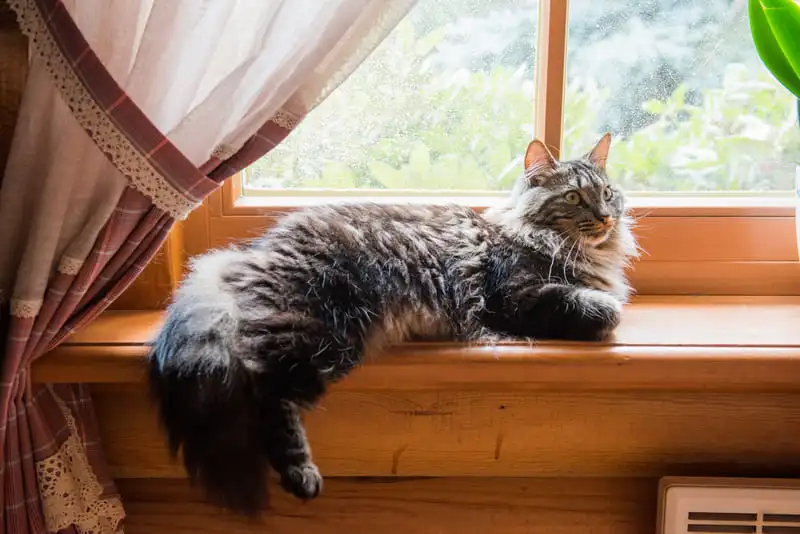
How much room does a cat need? Less than most people fear. There’s no official minimum for a pet home. The numbers you’ll find online come from cages and shelters:
| Standard | Figure | What it covers |
|---|---|---|
| USDA Animal Welfare Act rules | 3 sq ft of floor for cats up to 8.8 lb, 4 sq ft above that, 24 in high | Enclosures at regulated facilities |
| Association of Shelter Veterinarians | Under 8 sq ft unacceptable, 11 sq ft or more ideal | One cat housed in a shelter |
| Association of Shelter Veterinarians | 18 sq ft per cat | Cats housed together in a shelter |
A 10 by 10 foot bedroom is about 100 square feet, roughly nine times the shelter ideal for one cat. Floor space is rarely the real problem.
A better test comes from the same shelter vets. Can your cat eat and rest away from its litter box, stretch out full length, stand with its tail straight up, scratch, climb, perch and hide? If yes, the space is big enough. If not, more square feet won’t fix it.
That’s also the answer to how much room do cats need in a studio or small apartment. A 2016 review of the research found no strong consensus on floor space, but the feline guidelines agree that cats feel safer up high. Height is the cheapest space you can add.
Your First Two Weeks, Day by Day
Here’s how it usually plays out with a typical adult cat. Shy cats stretch every stage.
- Day 1: Straight into the stocked room. Open the carrier, show it the essentials and leave it alone.
- Days 2 and 3: Short visits at the same times each day. The ASPCA suggests sitting a few feet away and letting the cat come to you. Book the vet visit.
- Days 4 to 7: Add wand-toy play. If you have other pets, start swapping scents.
- Week 2: Check for all four ready signs. If they’re there, open one more room. In multi-pet homes, start room swaps once the vet gives the all clear.
- After week 2: Keep widening access a room at a time. If the cat still hides all day, upgrade the room and talk to your vet.
Through all of it, the safe room for cats stays put as the spot your cat can always go back to.