
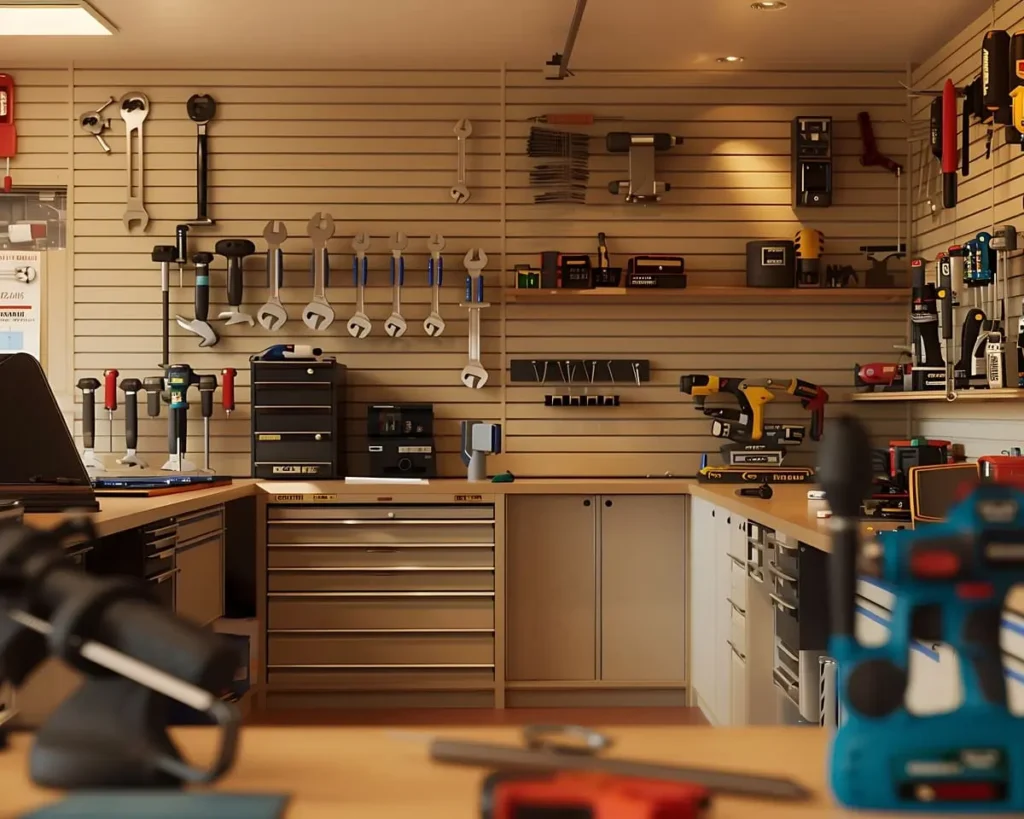
Your garage is well-lit until you open the hood, open a cabinet, or stand at your workbench, and then the light vanishes exactly where you need it. Useful garage lighting ideas start with those shadows.
Spread the main lighting across the room, give close work its own light, and put softer lighting on separate controls if the garage also serves as a gym or hangout. Fixture placement matters as much as the lumen number on the box.
Garage lighting ideas that actually light the whole space
The common problem is a single light in the center of the ceiling. Because all the light comes from one point, anything in its way casts a shadow. Overhead racks, tall shelves, and even your shoulders can cast a shadow on the workbench.
That is why replacing a bulb with one of much higher wattage is usually such a disappointment. You get more light, but it still comes from the same spot.
For a one-car garage, start by marking at least three or four fixture spots: one on the left side of the car, another on the right, one in front of it, and one bench light if necessary. Consider it only an approximation; depending on the size of the garage, ceiling height, and fixture output, there might be a need for more lights.
Mark your storage on the sketch before placing fixtures. According to pablo94sc, a member on the Garage Journal forum, the door hardware and the upper shelf may get in the way of your lighting plan. They are not hard to design around.
Put the main lights and the bench light on separate controls. You should be able to grab a screwdriver without lighting the whole workshop.
How much light does a garage actually need?
A general garage work area needs about 20 to 75 footcandles. This is 20 to 75 lumens per square foot of the surface to be illuminated. Small parts and detailed repair work may need more.
Here is what the sources recommend:
| Use | Light reaching the surface | Source |
|---|---|---|
| Parking and storage | About 10–20 footcandles (100–200 lux) | PacLights |
| Garage workshop, broad residential guidance | 20–75 footcandles (215–807 lux) | Super Bright LEDs |
| Workshop or hobby area | About 28–46 footcandles (300–500 lux) | PacLights |
| Vehicle repair and medium bench work | About 46–93 footcandles (500–1,000 lux) | Canadian Centre for Occupational Health and Safety |
These ranges overlap but do not match exactly. For general work activities, 50 footcandles on the work surface is good enough. Local lighting can be added for inspection purposes. According to PacLights, at least 750 lux, about 70 footcandles, is needed for precision auto repair.
Extremely hard visual work may demand much more light.
Why the 300-lumen figure needs context
The Bob Vila guide to garages says there should be 300 lumens per square foot for task lighting, and attributes this to the IES Lighting Handbook. The worked example in this guide uses this figure on a nine-square-foot workbench.
This is much higher than the numbers mentioned above for general workshops. No edition or page in the handbook was provided, so the numbers cannot be verified. There is also a difference in what is measured. Bob Vila’s figure describes bulb output, while footcandles describe light reaching the surface.
The two can only be compared once you account for light loss. When you compare garage lighting ideas, start with the surface targets in the table above.
A calculation you can use
First, distinguish two measurements:
- Lumens: the light a bulb or fixture produces.
- Footcandles: the light reaching a surface. One footcandle equals one lumen per square foot at that surface.
A 12-by-20-foot garage has 240 square feet of floor area. A target of 50 footcandles on a work plane of 240 square feet needs:
240 x 50 = 12,000 lumens to be directed onto this plane.
But purchasing fixtures of 12,000 lumens output will not automatically provide 12,000 lumens on the plane. Some light escapes, some is absorbed by walls and ceilings, and output drops over time as fixtures age and collect dust.
If 60% of the rated output reaches the work surface, you need:
12,000 ÷ 0.60 = 20,000 lumens (rated output).
It might be enough to install 4 fixtures of 5,000 lumens each. But this 60% figure is just an example and cannot be applied everywhere. For a precise number, ask the supplier for a layout calculation.
After installation is completed, measure the light at the points of work, such as the bench and engine bay, with a light meter. Do it with the car parked inside and the hood open.
LED garage lighting: fixture types and what each is for
With LED garage lighting, “four feet long” tells you surprisingly little about brightness. A slim integrated bar, one replacement tube, and a complete shop-light fixture can have very different outputs.
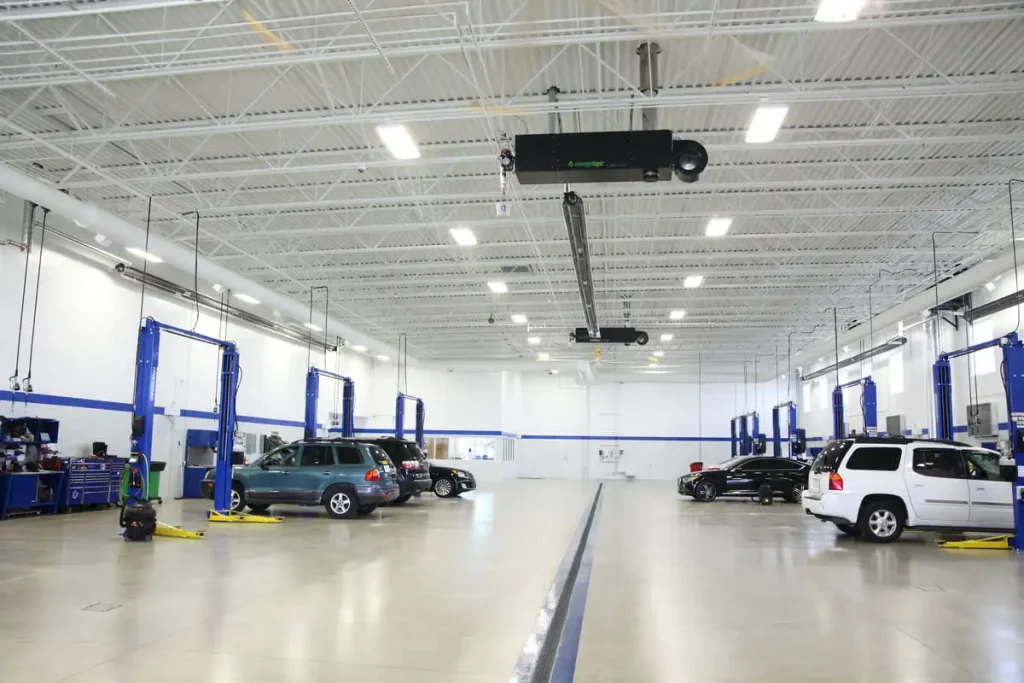
The figures below are manufacturer specifications. They are examples for comparing fixture types, not products we have tested.
| Type | Published output example | Where it makes sense |
|---|---|---|
| Slim four-foot integrated light | Barrina AAL20: 2,200 lumens per fixture | Several distributed lights or a light above a bench |
| Four-foot T8 replacement tube | Philips MasterClass InstantFit, 15.5W, 5000K: 2,500 lumens per tube | Updating a compatible existing fluorescent fixture |
| Complete four-foot shop light | Feit SHOP/4/4000/840: 4,000 lumens per fixture | Main overhead lighting in a workshop |
| Two-by-four-foot flat panel | Feit FP2X4/6WY/WH: 4,500 lumens per fixture | Broad lighting on a finished, low ceiling |
| Adjustable track head | WAC Charge 8010 5CCT: 865 lumens per head | Aiming light at shelves, displays, or a specific work area |
| Flexible white LED tape | Armacost RibbonFlex Pro, item 131210: 129 lumens per foot | Warm accent lighting beneath shelves or around a lounge area |
The frequently quoted 2,200–2,500 lumens works for some thin bars and separate tubes, but does not apply to all shop lights. Two 2,500-lumen tubes have 5,000 rated lamp lumens combined, before losses within the fixture.
If you are comparing LED lighting for garage use, check whether the stated output refers to one tube, one fixture, or an entire multipack.
Shop lights and T8 retrofits
Linear lights are simple to install over cars and benches. Linkable lights also reduce the number of cables needed provided you don’t exceed the limit imposed by the manufacturer in terms of linking.
If you are replacing existing fluorescent lights, note the type of light tube to be installed. According to UL Solutions, Type A light tubes require existing ballasts, meaning they have to be compatible. Type B light tubes bypass the ballast and are direct wired.
Panels, track lights, and strips
Panel lights would suit your finished garage because they are close to the ceiling and distribute light across a wide area. Check the dimming rating. The Feit panel above is not dimmable.
Track heads will allow you to control the direction of the light. However, two small track heads will provide insufficient light for the workroom.
A light strip will be useful under shelves and the TV set. Use white task lighting when inspecting parts. Accent strips should not be the only light source for that. If part of the garage is a hangout, see our gaming room decor ideas for that corner.
Where to put the lights
Even good garage lighting ideas fail if the fixtures sit in the wrong place. Begin by positioning the car where it would usually be parked before deciding where to place your fixtures.

A Bob Is The Oil Guy forum member named Snagglefoot described a good setup: one light across the front of the car, parallel to the bumper, and more lights along each side.
This is what the basic plan would look like:
- Along the front: mount a fixture parallel to the bumper, ahead of where the raised hood sits. Check that the open hood does not block it.
- Along the sides: install lights for the work aisle on both sides of the vehicle. Open the door to make sure that you are able to see the sill, seat, and the tool tray.
- Over the workbench: install task lighting over the workbench ahead of your normal standing position. You may find it helpful to use under-the-shelf mounting to prevent obstruction by the overhead cabinet.
This will help to reduce the most frequent shadows. This cannot eliminate all the shadows from the engine compartment and wheel wells. You should bring along a portable inspection light for such jobs.
Now open the overhead garage door. Check that the panels of the raised door do not obstruct your proposed lighting fixtures.
Do not select spacing based on the symmetry of the ceiling alone. While a light placed right above the roof of the car seems symmetrical, it might not serve its purpose at all.
Color temperature: what to actually buy
For LED garage lighting, start with 4,000–5,000K. PacLights recommends this neutral-to-cool range in its garage design guide.
Select 4,000K if you do not want an extremely cool lighting style for the garage. Choose 5,000K if you prefer a cooler, crisper light for workshop tasks.
The two numbers can both be found in conversations between Garage Journal owners, as tre873 and coljar use 5,000K and 4,000K respectively. It comes down to preference. Try one fixture before buying a full set.
A regular warm light in a living room is around 2,700–3,000K. The U.S. Department of Energy provides this temperature range for products designed to emulate incandescent light. Garage workshop light is cooler and crisper. Warm light will serve well in a separate seating area.
Whichever garage lighting ideas you go with, be consistent in the color temperature for the work light. Also consider using high CRI, 90 or higher, for painting, color matching, and finishing work.
Smart and motion-sensor lighting
Motion sensors work well when you walk into the garage with your hands full. They work less well during repairs, when the lights can shut off because you are barely moving.
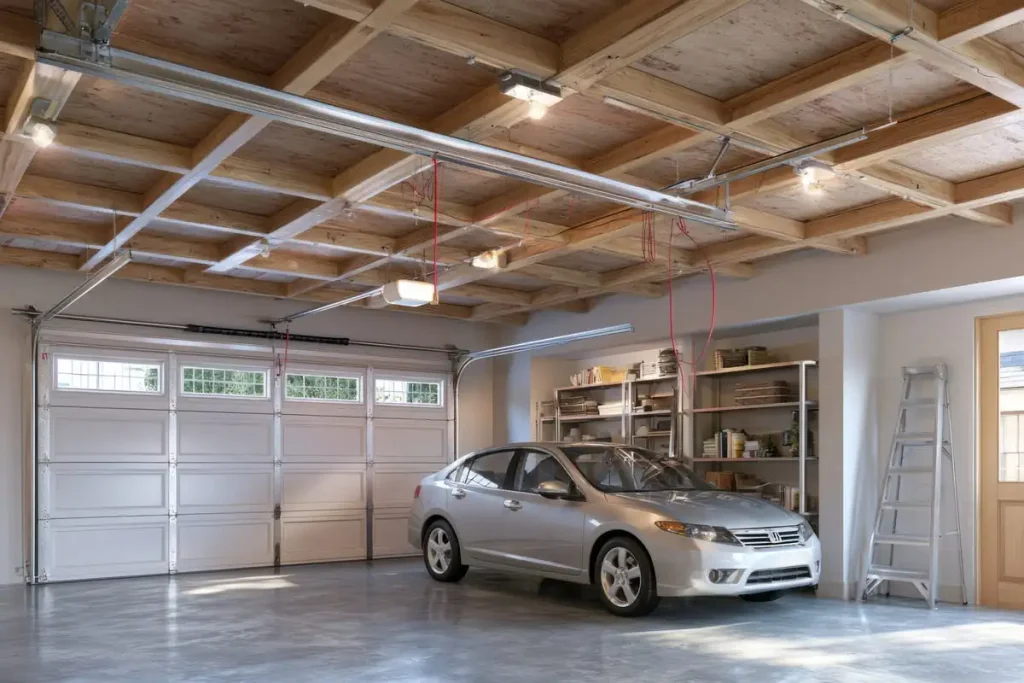
Buy one that allows you to adjust the timeout period and to turn the light on manually. Study the label and look for wording such as “manual on / auto off,” which means that you activate the light while it turns itself off once the room is vacant. Install it in a place where neither your parked car nor shelving obstructs its operation. If the garage is also a way into the house, see our picks for smart door locks with camera.
The most useful garage lighting ideas for a shared workshop and hangout give each activity its own setting. For example:
- Arriving: overhead lights come on automatically.
- Working: main lights and bench lights stay on at full output.
- Relaxing: main lights dim or switch off while warm shelf lighting stays on.
Choose your devices according to the dimming capabilities that you require. A smart plug will turn on or off a plug-in light but it cannot dim the light itself.
Since smart bulbs require continuous electricity supply in order to function, the wall switch has to stay on. The Philips Hue instructions state this quite clearly.
Not sure which to use? See our comparison of a smart light switch vs smart bulb.
Before you buy: electrical planning
Before buying LED lighting for garage work, find out what the existing circuit already supplies. The lights often share one breaker with the opener, a freezer, or shop tools.
Before you commit to any garage lighting ideas, make a list of the lights and other devices you wish to connect simultaneously. You can use the input wattage or amperage from each device’s nameplate. “100-watt equivalent” is a measure of light output only. It doesn’t refer to the amount of electrical consumption of the lamp.
Four Feit shop lights with 52 watts each consume 208 watts. It is the wattage consumption of lighting only. A heater or power tool can dramatically affect your electrical load calculations.
Ask an electrician whether you need a new circuit and whether the lights should be separated from the tool receptacles. Being able to keep the lights on after a tool trips the breaker is one reason to do it.
An electrician will assess the wiring capacity and protection of the circuit. Think about outlet placement too. Choose plug-in lights if outlets are present. Extension cords are for temporary use, according to the Electrical Safety Foundation International. Follow the fixture’s installation instructions.
A small trick worth knowing
A simple hack from a Garage Journal thread on opener lighting: take one bulb out of the opener, screw in an Edison-base socket-to-outlet adapter, and plug an LED shop light into it.
The benefit is extra light that runs on the opener’s courtesy-light timer. The downside is compatibility.
A socket adapter does not imply the compatibility of the opener with an external light fixture. For example, the widely popular Jasco socket adapter will provide you with only a two-pronged outlet to be used indoors. It will not provide you with an equipment ground for a three-pronged light fixture, and it will not increase the capacity of the socket of the opener.
Use it only if your opener’s manufacturer approves it. Otherwise, use either a remote light kit or a motion sensor light.
Check for compatibility with bulbs as well. According to Genie, some LED bulbs can interfere with the opener’s radio signal. Opener-compatible bulbs may prove to be a far simpler solution.
Leave your primary lighting separate from the opener. Your courtesy light timer should never determine when you finish with the repairs.
What to look for in the best garage lighting
The best garage lighting for your space should match the work, mounting positions, and conditions. Compare these details before buying:
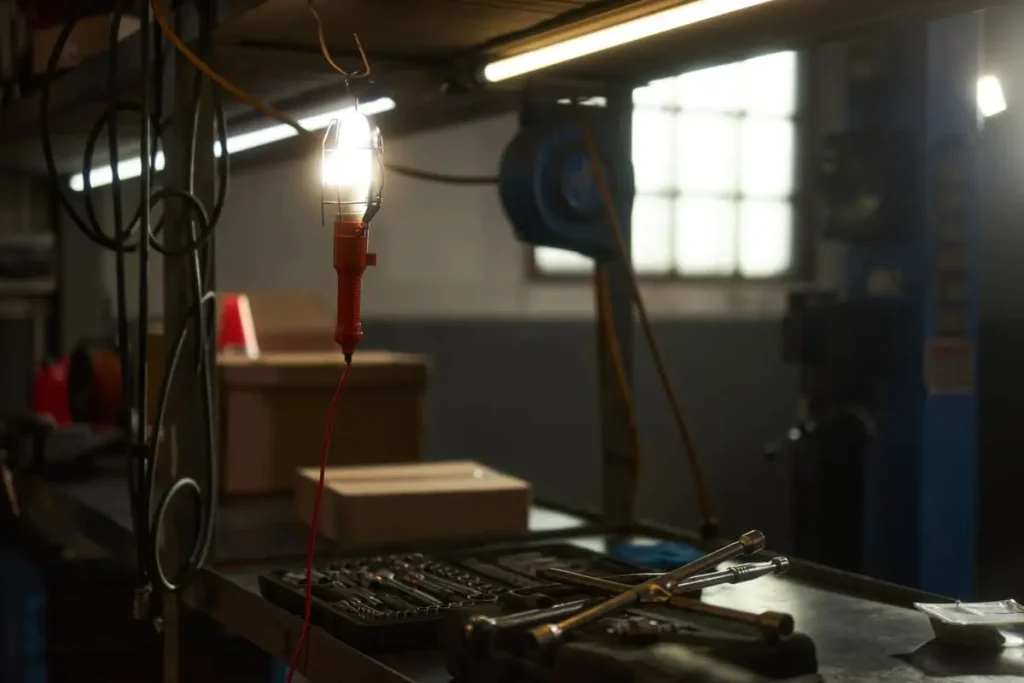
- Output: lumens per fixture, plus enough fixtures for even coverage.
- Light quality: 4,000–5,000K for work, comfortable diffusion, and suitable color rendering.
- Environment: an operating-temperature range that covers your garage, plus an appropriate damp or wet rating where needed.
- Installation: compatible wiring, supplied mounting hardware, and a stated linking limit.
- Controls and support: the dimming or sensor functions you need, a recognized safety certification such as UL or ETL, and clear warranty terms.
Judge garage lighting ideas by delivered coverage and usability, not just the largest lumen claim.
FAQ
First, choose a target between 20 and 75 footcandles, which means 20 to 75 lumens per square foot on your work plane. Next, multiply the work plane area by the target and account for light loss.
How many lights should a single-car garage have?
Consider installing three to four lights: one each on the two sides of the vehicle, one at the front, and one above the bench. The exact quantity will depend on the number of lumens produced per light, ceiling height, obstructions, and work done. Four 2,200-lumen lights give 8,800 rated lumens.
Is 4,000K or 5,000K better for a garage?
Both will serve well. 4,000K is warmer in color and fits well for a multi-purpose garage. 5,000K is whiter in color and may suit better when working. Compare lumens individually, and test one fixture first if you are unsure about the color.
Can I replace fluorescent garage tubes with LEDs?
Yes, with a compatible product. A Type A LED tube runs on the existing ballast, so the ballast must be compatible. A Type B tube bypasses the ballast.
Are motion-sensor lights suitable for a workshop?
Yes, but only if the sensor is appropriate for stationary work. Consider an adjustable timeout feature and a manual stay-on setting. Test it with the car parked to see if the view of the sensor is blocked. A second light for the bench is needed if there is little movement involved.
Do garage lights need a dedicated circuit?
Not always. It will depend on the circuit that already exists, other devices using the circuit, additional fixtures you install, and the electrical codes where you live. An electrician can check if there is a need for an additional circuit. Separating work lights from tool receptacles means the lights stay on when a tool trips the breaker.