
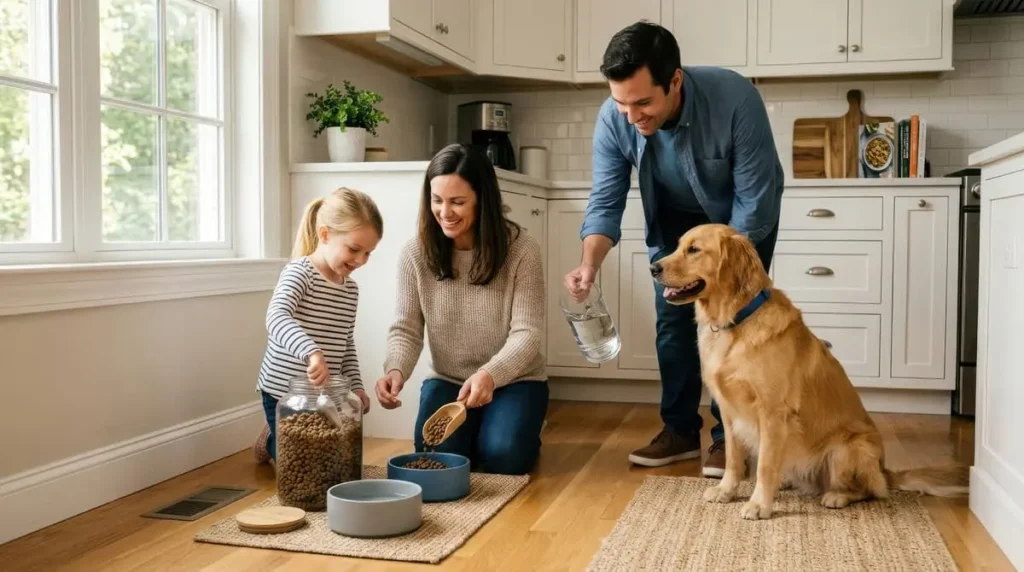
A dog chore chart lists all the chores your dog needs, the person responsible for each one, and a tick box to check that the task is completed. The tick box plays an important role. It prevents a double breakfast for your pet, and it also shows when nobody took the dog for the evening walk. We present you with a free printable chore chart with daily, weekly and monthly tasks for your whole family, adults included, without any registration. In the text below you will find what should be on the chart, suitable chores by age, a sample schedule, and ways to stop the chart from getting ignored.
What Goes on a Dog Chore Chart
Dog care runs on three clocks: every day, every week and every month. A good dog chore chart puts all three on one page, so the jobs nobody thinks about, like washing bowls or the monthly heartworm pill, get done too.
| Task | How often | Why it’s on the chart |
|---|---|---|
| Breakfast and dinner | Daily, at set times | A tick per meal is the easiest way to stop double feeding |
| Fresh water | Daily | Rinse and refill, don’t just top up |
| Wash bowls and scoop | After each meal | The FDA says to wash them with soap and hot water after each use |
| Potty breaks | Morning, midday and last thing at night | The midday one is the first to get skipped |
| Walk | Daily | The chore that slips first in most homes |
| Poop patrol in the yard | Daily | Easier as a two-minute daily job than a weekly one |
| Play or training | Daily, about 10 minutes | Easy for kids to own |
| Brush the coat | Weekly, more for long coats | Cuts shedding around the house |
| Wash bedding and soft toys | Weekly | Keeps the dog’s spot from smelling |
| Restock poop bags and food | Weekly | So nobody finds an empty bag at 7 a.m. |
| Heartworm and flea and tick prevention | Monthly | Most heartworm preventives are given monthly, and missed doses are easy to forget |
| Nail trim and weigh-in | Monthly | A monthly weight shows if meals or treats are creeping up |
These are the dog chores most households end up sharing. Our printable has the daily ones on page 1 and the weekly and monthly ones on page 2, with a dog info card for food amounts, medications and the vet’s number.
Why Most Chore Charts Fail
It’s not the chart itself that’s the issue; it’s the process that surrounds the chart. On a parents’ forum, a parent with three older children described how they have things set up: “Right now I am rotating weeks between the older three.” Other parents then discussed where things fell apart after that. Nobody “can remember whose week it is for which chore,” and eventually one adult ends up doing it for everybody. As one parent said, “I’m the only one who remembers on a regular basis.”
Here’s what fixes it:
- Allocate each task and its time to one person. “Choose one person and assign them a time to do the chore,” recommended one of the parents. “Sam, breakfast at 7:00” is better than “Sam’s week.”
- Rotate monthly rather than daily or weekly. “If I had to do it over I’d probably rotate on a monthly basis,” explained another parent. The longer period results in less quarreling over whose turn it is.
- Position the chart where the work is done. Put it beside the food bin or the leash hooks, not on the fridge door that gets no attention whatsoever. Already have a certain location in mind? Our dog feeding station ideas show where a chart and a food storage bin can go.
- Tick the box at the bowl, not from memory. One of the parents uses a dry-erase board where sticky notes initially go into the “to do” column and get moved once the chore is completed. A tick box inside a sheet protector performs the same function.
- Don’t forget to include the adults on the dog chore chart. During a conversation about a young teenager who refused to walk the dog they had pleaded for, one of the parents said, “Pets are always the responsibility of the adult.”
Dog Chores by Age
Children are capable of helping from age 4, but the owner of the dog is always an adult. A University of Arkansas extension chore list includes “feed pets” for children ages 4 and up. The CDC adds two requirements for families with young children: supervise children under 5 when they interact with animals, and require everyone to wash their hands after feeding a pet or handling pet food.
Safety comes next. Every year, about 4.5 million Americans get bitten by dogs, and the injury rate is highest for children ages 5 to 9, says the fact sheet from Oklahoma State University based on CDC statistics. The same fact sheet says: “Do not disturb a dog that is sleeping, eating or caring for puppies.” Therefore, young children may put the bowl down, but they should not hover over a dog while it eats.
| Age | Chores they can own | Do with an adult |
|---|---|---|
| Under 5 | Put toys away, help pour measured food into the bowl | Everything else, followed by handwashing |
| 5 to 8 | Fill the water bowl, brush the dog, 10 minutes of play | Feeding, walks and poop pickup |
| 9 to 12 | Feed meals with the amount written on the chart, wash bowls, poop patrol with a bag, basic training | Walks off the property, nail trims, medication |
| 13 and up | Walks (if they can hold the dog on a leash), bathing, restocking supplies | Monthly preventives, vet visits |
| Adults | Medication, vet visits, and checking the chart every Sunday |
Some parents reserve the key responsibilities for themselves. “I’d delegate the poop-scooping or stuff like that, but not feeding or potty breaks,” one parent commented. Another parent gives children more responsibilities as they get older: “I assign jobs more by age (the older the child is, the more challenging the job).” Either way works. What is essential is that the chart clearly shows who is responsible for each job.
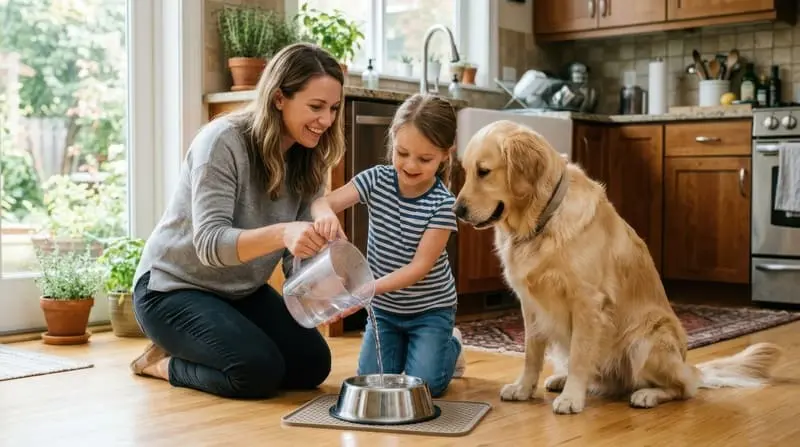
A Sample Dog Daily Schedule
Here’s a dog daily schedule for an adult dog in a home where the adults work regular hours. Change the times to fit your day, then copy them onto the chart.
| Time | Task | Example owner |
|---|---|---|
| 6:30 a.m. | Potty break and a short walk | Adult 1 |
| 7:00 a.m. | Breakfast, fresh water, wash the bowl | Teen |
| 12:30 p.m. | Midday potty break | Whoever is home, a neighbor or a dog walker |
| 4:00 p.m. | Play or training, 10 minutes | Younger child |
| 5:30 p.m. | Evening walk | Adult 2 |
| 6:00 p.m. | Dinner, wash the bowl | Older child |
| 6:30 p.m. | Poop patrol in the yard | Teen |
| 10:00 p.m. | Last potty break | Adult 1 |
Puppies and senior dogs need more potty breaks, so ask your vet how often. Whatever times you pick, keep them the same every day. A predictable dog routine helps with house training, and it helps your household remember the chores.
Build a Dog Walking Schedule That Sticks
Walking is important not just for your dog but for yourself too. According to a study by Michigan State University, people who owned and walked their dogs were 34% more likely to meet national exercise guidelines. However, only about two-thirds of the dog owners in the study walked their dogs regularly.
A dog walking schedule holds up better when:
- Each walk has one name. “Whoever’s free” usually means nobody.
- The walk is tied to something that already happens, like right after breakfast or before the adults start dinner.
- Weekends get their own row. Weekday routines fall apart on Saturdays.
- Every walk has a backup. Write a second name in small letters for days when the first person is out.
Mark the walk on the dog chore chart as soon as you’re back through the door, with the leash still in your hand. If your yard does part of the exercise job, our outdoor dog area ideas cover play features for the days the walk is short.

Feeding: The Chore Most Worth Tracking
Double feeding happens in busy homes because each person thinks the other one forgot. Do that a few times a week and it shows on the scale. In a survey of 1,100 adult dogs at UK pet shows, 65% were overweight, according to a 2018 study in a veterinary journal.
Treats creep up the same way. “Treats and additional food items should not exceed 10% of the daily caloric intake,” says the UC Davis School of Veterinary Medicine. Our dog chore chart has a treat tally row for that reason. Write the amount per meal at the top, say “1 cup,” so a new helper doesn’t guess, and tick each meal as it goes down.
How to Set Up the Printable
The printable works as a ready-made dog schedule template: fill it in once, then reuse it every week.
- Print all three pages on plain paper or card stock. Page 1 is the weekly chart, page 2 has the weekly and monthly jobs plus the dog info card, and page 3 is blank.
- Write the names and times in before you hang it. Use the sample schedule above as a guide.
- Slide it into a sheet protector or laminate it. A dry-erase marker lets you wipe it clean every Sunday.
- Hang it where the jobs happen, like beside the food bin, by the back door or near the leash hooks. Our dog corner ideas show how to set up one spot for leashes, towels and the chart.
- Do a 5-minute Sunday check. Look at what got missed, fix the time or the owner, and wipe the week.
- Rotate once a month, not every week.
The blank third page turns the printable into a dog schedule template for anything ours doesn’t cover, like a puppy’s potty breaks every couple of hours, medication times or a recovery plan after surgery. Fill in the dog info card on page 2 too. It doubles as a note for a pet sitter.
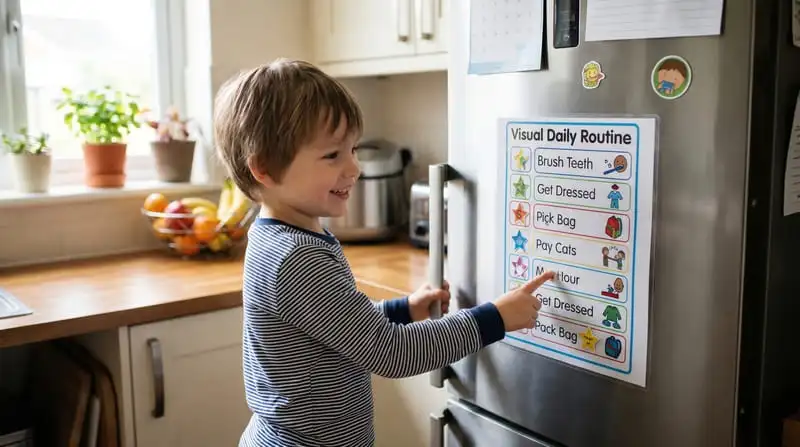
Got More Than One Pet? Make It a Pet Chore Chart
Give each animal its own rows and color. Two dogs who eat at different times need separate feeding ticks, or one of them ends up with two dinners. For a cat, use the blank page as a pet chore chart. The CDC recommends cleaning the litter box daily, and it says pregnant women should avoid changing it if they can, which is worth noting on the chart. If you have two dogs, add a dog walking schedule row for each one, since they rarely need the same walk.
Dog Chore Chart FAQs
Feeding at set times, fresh water, washing the bowls, three or four potty breaks, a walk, poop pickup in the yard and a few minutes of play or training. Those daily dog chores are easier to share when each one has a named owner and a fixed time.
What Should Be on a Chore Chart?
Each task, how often it happens, who owns it and a box to tick each time. On a dog chore chart, also write the food amount per meal and the treat limit. A pet chore chart for a home with several animals needs one row per animal, and the blank page of our printable works as a dog schedule template for jobs that change, like medication.
What Is a Good Daily Routine for Pets?
The same times every day for meals, potty breaks, a walk and some play, with a calm last potty break before bed. Use the dog daily schedule above as a starting point. A steady dog routine matters more than the exact times you choose.
What Does a Pet Need Every Day?
The right food at the right time, fresh water, a clean bowl, bathroom breaks, exercise, attention, and a quiet place to sleep. Page 1 of our printable covers most of these daily needs for a dog.
What’s the 90/10 Rule for Dogs?
It is a treat rule. At least 90% of a dog’s daily caloric intake should consist of balanced food, and treats or extras should make up no more than 10%, as mentioned by UC Davis. Counting treats on the chart helps you stay under that limit.
Can a Dog Be Left Alone for 8 Hours a Day?
While some adult dogs can spend part of a workday on their own, eight hours without a bathroom break is quite a long time for most. Young and old dogs will require more frequent breaks than that. That’s why the schedule above has a midday break. If nobody is home, a neighbor or dog walker can take that row, and a steady dog routine before and after work helps the dog settle.
At What Age Can a Child Take Care of a Dog?
Kids can help from about age 4 and own real chores from about 9 to 12, but no child should be the only one responsible. Use a dog chore chart that lists the adults too, so feeding, walks and vet visits never depend on one person’s memory.