
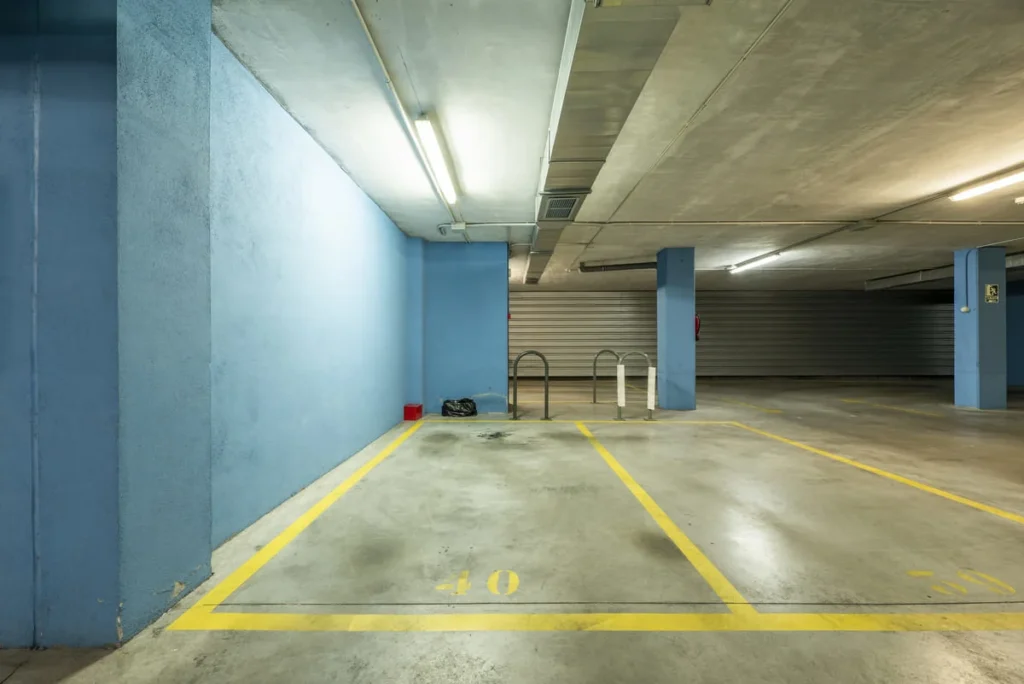
Most garage paint ideas start at the walls. A real garage project doesn’t do that. As the time comes to choose the wall color, chances are that the floor will already be completed – be it coated with epoxy, flaked or chosen by then. It’s the walls which should complement the floor, not vice versa.
These garage paint ideas stick to the real order of things and start with the floor. On your journey through the guide you will come across the paint colors that are selected for garages along with their numbers and Light Reflectance Value (LRV) scale from 0 to 100.
Start with your floor, not your walls
Floor usually comes first in most garages. It’s typically the bigger investment, and many people have it installed before ever thinking about their walls. Once it’s there, that’s the fixed element. The color of your walls must complement the floor.
That’s why you should study your floor before even looking at a color chip.
- Flake floors: check the mix. Black, gray and white flakes appear cool. Brown, tan and black flakes appear warm. Choose wall colors that share the same temperature.
- Gray floors: one popular choice is Behr Battleship Gray (N360-4), found in Behr’s 1-part epoxy garage floor paint. It’s a classic mid-gray that leans toward warm hues, making it more appropriate to use with warm whites and greiges rather than cool blue grays.
- Concrete floor: it appears warm, irregular gray. Consider it a warm neutral.
Try to get a contrast in value, not just color. A mid-value floor with walls a few steps lighter than that appears intentional. Matching value on walls and floors turns the room into a gray box.
One point regarding the order in which things should be done. If you haven’t put a sealer on the floor, paint the walls and ceilings first. A drip on the concrete floor is one thing, but a drip on the freshly sealed floor is a whole new problem.
Pick your color by how you actually use the garage
Most garage paint ideas are sorted by color. It works better to sort them by use. Ask what the garage does on a normal Tuesday, then pick from the matching group.
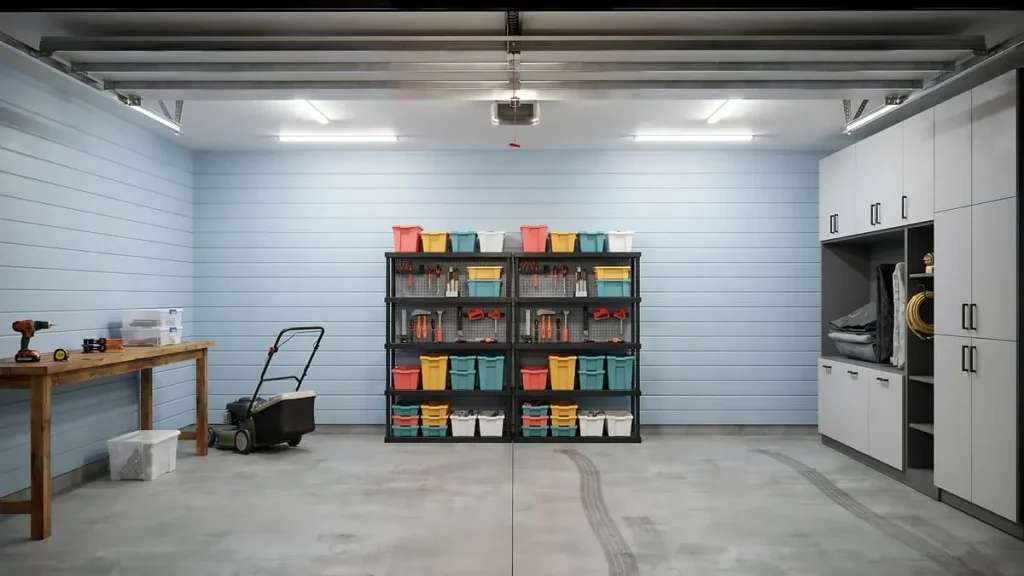
Workshop/active area: keep light. If it’s where you build, fix, and train, then light trumps everything else. Light colors reflect more light back into the space from the fixtures, meaning more light for the task. A warm white like Benjamin Moore Swiss Coffee (OC-45), which has a light reflectance value of 82, will reflect 82 percent of light hitting the wall. The alternative? The Sherwin-Williams Misty (SW 6232, LRV of around 64), which is a pale blue gray, has a light and fresh appearance but isn’t clinical.
Car Display/Showroom: Go for dark colors. When the function of the garage is to display a car, dark walls will bring the car to prominence. Dark colors like charcoal, deep navy, and black will bring the paint, chrome, and trim work of the vehicle into prominence. Note that with dark walls, you will need additional lighting as they absorb most of the light from your fixtures. Want to hang art on those dark walls? Here’s how to do it with our moody wall decor ideas.
Storage only: go for a forgiving neutral color. A garage packed with storage bins, bikes, and a lawnmower will need colors that will hide the dust, marks, and fingerprints. Greige and taupe fit in here. Agreeable gray from Sherwin-Williams is so popular with homeowners that it is now a running joke among garage owners. This neutral gray sits between gray and beige and conceals dirt better than white.
The welding and workspace exception
One scenario where white walls become a hindrance to you is when you have to perform welding work inside your garage. In such a situation, light and white walls will reflect the arc’s light back at you and everyone else who happens to be near. Working under white lighting conditions while welding can be quite unpleasant, and this is precisely what safety regulations regarding welding seek to minimize.

The welding safety standard set by the OSHA (29 CFR 1910.252) recommends, where feasible, working in booths or behind screens which have been painted with low reflection finishes. Two types of pigments recommended for painting booths are zinc oxide, which absorbs ultraviolet radiations from the welding arc, and lamp black, which is a form of carbon pigment and one of the darkest forms of paint available.
It is not necessary to paint the entire garage black. Instead, paint the welding area and/or the wall behind the welding table with a dark gray or even black color. Keep the gloss level low, such as eggshell, since the more gloss a paint has, the more reflective it will be. If you’ve attached some sheet metal behind the welding table for sparks, paint it dark as well.
Why everyone’s tired of gray
Gray floor, gray walls, gray cabinets. Gray-on-gray was the default choice, and now many people regret making that choice. All-gray garage looks cold and bland, like an illuminated concrete box. The best garage paint ideas right now bring warmth back in.
Colder grays only make the situation worse. Sherwin-Williams Passive (SW 7064, LRV 60) is a very good paint in itself, yet the blue undertone of this paint makes the space look colder if used near the gray floor.
A solution to this problem is not an eye-catching paint; it’s a warm off-white. Swiss Coffee is the one paint that garage owners seem to choose all by themselves. It’s a creamy white with just enough warmth to soften the concrete, and neutral enough not to clash with gray epoxy or flake floor. You keep the light space but eliminate the cold-cave look.
If you prefer keeping your garage colors in the gray family, switch to the warmer shade of gray, instead of choosing darker colors. Agreeable Gray is greige. Sherwin-Williams Antimony (SW 9552, LRV about 57) is a soft and balanced gray without a blue undertone. Check the chosen shade yourself on the wall, above the floor.
Garage wall ideas that actually hold up
Color gets the attention, but finish decides how your walls look two years from now. The garage wall ideas that last all follow the same rule on sheen.
- Satin or eggshell finish on most walls. Easy to wash, low on glare, and hides drywall imperfections well.
- Use a semi-gloss for molding, doors, and surfaces that take a lot of handling. Most difficult to clean but reveals any dents and blemishes.
- Never a flat finish. Scuffs easily and can’t be wiped clean.
- Never high gloss. Every light will reflect off this finish.
Consider the question of depth. Mid-tone colors cover up grime better than either very light or very dark colors. Bright white picks up the marks made by tires, grease, and fingerprints. Nearly black picks up dust, salt, and every little nick and scratch. Light to medium gray such as Benjamin Moore Harbor Gray (AC-25, LRV 56, also called Silver Chain 1472) falls into the forgiving range.
The preparation is important as well. Clean off the exhaust and grease buildup using degreasing agent first. If you have new drywall, use a primer before painting. Concrete block requires primer as well, or the paint will absorb unevenly and look mottled.
The two-tone technique, with real numbers
Of all the garage wall ideas here, this is the most practical for a hard-used garage, and it’s an easy DIY job.
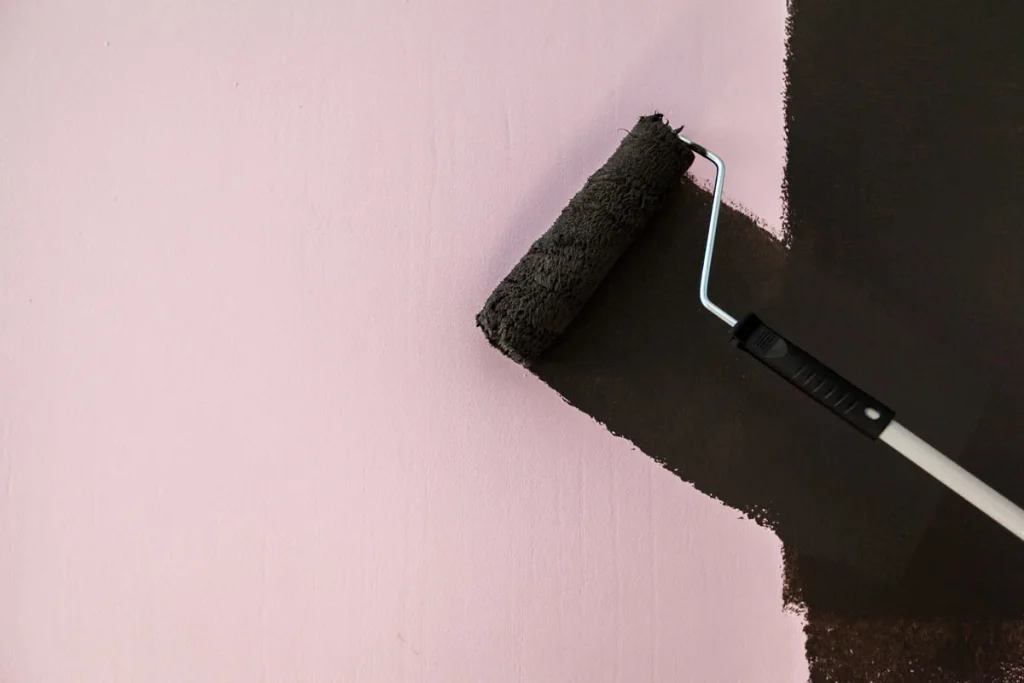
The layout: a band of dark color (black or dark gray) 12 to 18 inches tall along the bottom of the wall, your lighter main color above it, and a narrow reveal line of ceiling color at the very top.
- Apply paint for your lighter color to the entire wall surface and allow curing time.
- Apply a guideline about 12 to 18 inches above the floor using a chalk line or laser level to keep the line straight. Usually, slabs slope in a downward manner towards the entry point, so ensure you check the line throughout the wall.
- Apply tape just above the guideline. Then apply a thin layer of your main color to seal the tape. The sealing will prevent any seepage of the dark color beneath the tape line.
- Apply two layers of your dark color paint to the band at the bottom.
- Peel off the tape while the second layer of the dark color is still wet.
- At the uppermost portion, use a tape to apply a line a few inches away from the ceiling and then apply the ceiling color.
Why 12 to 18 inches? That’s the strip that takes the abuse: tire spray, mop water, boots, the snow blower, the shop vac. A dark band hides it. It’s also the part you’ll touch up most, and a strip that size is quick to redo.
Garage ceiling ideas
The safe default for garage ceiling ideas is white. Almost all garage light comes from overhead fixtures, and most garages have few windows. A white or very light ceiling catches that light and bounces it back down onto the floor and your work.
The look people are gravitating toward right now flips it: white walls, black ceiling. A black ceiling makes trusses, door tracks, the opener, ductwork and wiring fade out of sight, so the room looks cleaner and more finished. Pair it with bright fixtures, since a black ceiling soaks up light a white one would return.
The underused option sits between those two: a colored ceiling. A soft blue-gray like Misty overhead, or a ceiling that picks up your cabinet or accent color, makes the garage feel designed without darkening it much. If the garage doubles as a workspace, keep the ceiling color light (an LRV around 60 or higher).
Whichever of these garage ceiling ideas you pick, a flat ceiling paint is fine up there. Ceilings rarely get scrubbed, and flat paint hides roller marks and drywall seams.
Matching your garage to your house
An attached garage is part of the house. It looks better when it’s painted like one. Pull your interior garage colors from the same family as the outside of the home.
- Siding: a gray or blue exterior points toward cool whites and blue-grays inside. Tan siding or red brick points toward creams and greiges.
- Trim: repeat your exterior trim color on the interior door casing or baseboards to tie inside and outside together.
- Garage door: if the door is a strong color (black, navy, a wood tone), use it as your accent. Put it on the two-tone band, the cabinet fronts, or one feature wall.
Check the door into the house, too. When it’s open, the mudroom or kitchen color sits right beside your garage walls, so pick something that looks comfortable next to it.
How lighting changes what your paint looks like
Most garages get little natural light, so your bulbs decide what color your walls really are. Two numbers on the box matter.
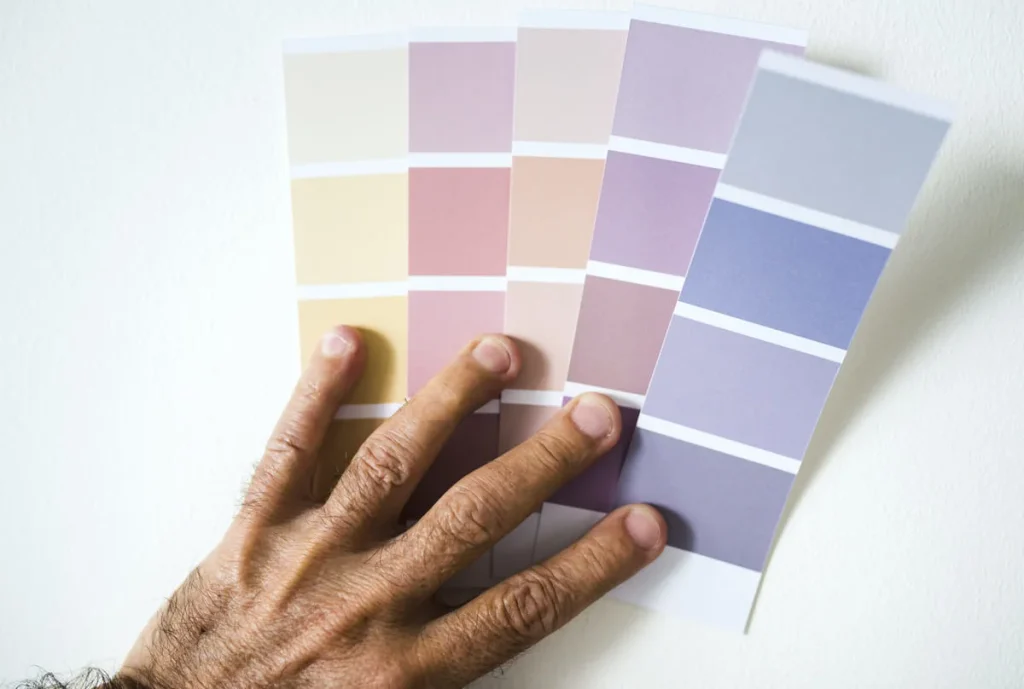
The first is color temperature, measured in Kelvin (K).
- 2700K to 3000K is warm and yellowish. It brings out creamy and yellow undertones, so a warm white like Swiss Coffee can look almost buttery.
- Around 4000K is neutral. Colors read close to the paint chip.
- 5000K is cool daylight, and it’s popular in workshops. It pulls out blue and gray undertones, so whites look crisper and cool grays like Passive can turn noticeably blue.
The second is the color rendering index (CRI), a score out of 100 for how accurately a light shows color. CRI 80 is the usual minimum for interior lighting, and 90 or above is considered excellent. Budget shop lights often sit near that floor, which can make paint look flat.
The practical rule for any of these garage paint ideas: settle your lighting before you buy paint, or at least lock in the color temperature. Then test samples under those lights, on the actual wall, at night with the door shut. For fixture choices, spacing and brightness, see our garage lighting guide.
FAQ
It depends on how you use it. Workshops do best with light colors like white, pale gray or pale blue, because they make the most of your lighting. Show garages suit darker, bolder walls that make a car stand out. Storage garages do well with greige or taupe, which hide dust and scuffs. If you’re unsure, a warm off-white like Swiss Coffee works with most gray floors.
What paint finish is best for garage walls?
Satin or eggshell for most wall area, and semi-gloss for trim, doors and high-contact spots. Avoid flat paint, which marks easily and won’t wipe clean. Avoid high-gloss too, since it reflects glare and shows every dent in the drywall.
When is the best time of year to paint a garage?
Spring. Interest in garage painting peaks every April through June, and for good reason: you can leave the garage door open for ventilation, and temperatures are usually warm enough for paint to cure. Standard latex paint needs 50°F or warmer while you paint and ideally for 48 hours after. Some formulas are rated down to 35°F, so check the label, especially in an unheated garage.
What are the most popular garage paint ideas right now?
The biggest shift is away from gray-on-gray toward warm off-whites like Swiss Coffee. In working garages, two-tone walls with a dark band 12 to 18 inches tall along the bottom are common, since the band hides scuffs and splash. Overhead, white walls with a black ceiling is the look people are gravitating toward.