
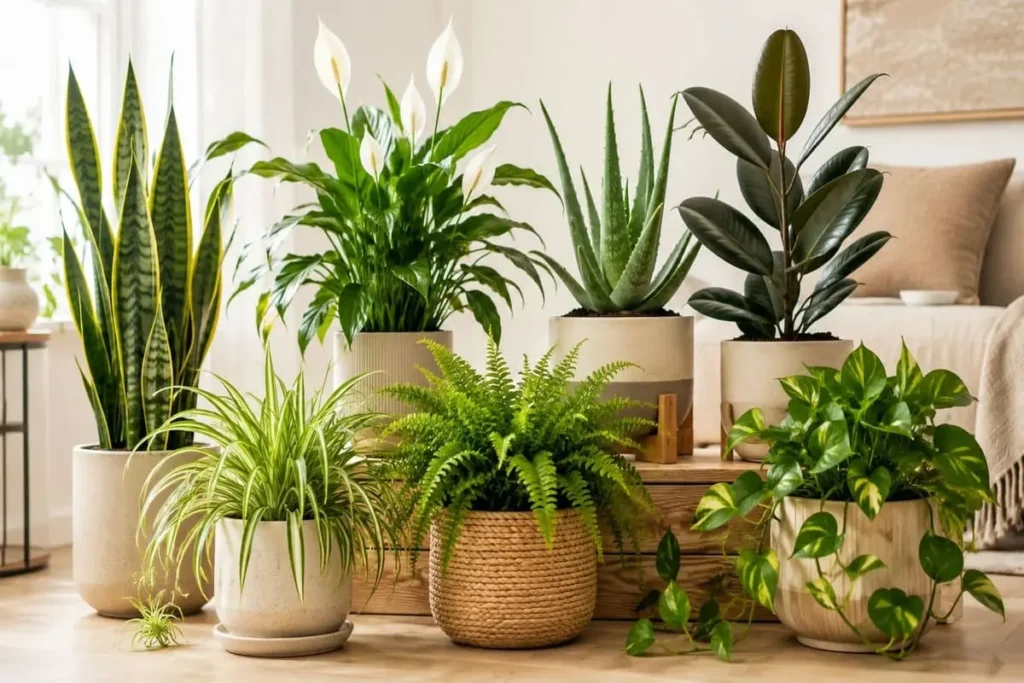
Air purifying plants are often sold with an appealing promise: place a few around your home, and they will quietly clean the air for you.
This idea has helped turn air purifying plants into one of the most popular categories in garden centres and online plant shops. It is a nice promise. It is also a considerable stretch of what the research actually found.
Some plants can absorb small amounts of airborne chemicals under controlled laboratory conditions. A living room is not a laboratory chamber, though. It has doors, windows, furniture, people moving through it and, in most cases, some level of ventilation.
That does not make houseplants pointless. It simply means they are better chosen for their appearance, care requirements and suitability for your home than for claims printed on a plant-shop label.
Can Houseplants Really Purify Indoor Air?
Most modern claims about air purifying plants can be traced back to NASA research conducted in the late 1980s.
Researchers found that some plants and the microbes in their soil reduced levels of toxic chemicals like benzene, formaldehyde and trichloroethylene when placed in sealed chambers.
The study found a good scientific answer to an interesting question but failed to reproduce an ordinary house.
Air in houses moves out and in all the time as there are windows, doors and vents and other tiny spaces through which air gets out or in. There are multiple sources of pollution and the plant in a corner has hardly any influence on them compared to this exchange of air.
A further study examined 12 different studies of various plants and translated their results into a form which allowed comparison to normal ventilation of buildings. It was found that an impossible number of plants was necessary for any effect.
So, no, two snake plants and a peace lily will not solve poor indoor air quality.
If it is because of any type of smoke, dampness, molds, chemicals, or pollution because of the furnishings and construction materials then the solution is to go to the root cause of the problem. Outdoor cleansing of ventilation and the proper use of filters are much more helpful.
People searching for the best indoor plants for air quality should therefore understand that no houseplant can replace effective ventilation or filtration. The best indoor plants for air quality are the ones that suit the room and remain healthy there, not plants expected to remove meaningful amounts of pollution.
You can still keep the plants. Just choose them for what they genuinely bring to the room.
Seven So-Called Air Purifying Plants That Are Still Worth Growing
The following plants regularly appear on lists of air purifying plants. Their practical value has less to do with filtering pollutants and more to do with their appearance, resilience and ability to cope with indoor conditions.
These air purifying indoor plants are frequently marketed as a type of natural filtration system, but that description overstates their real-world effect. When choosing air purifying indoor plants, focus on their light, humidity, watering and space requirements instead.
Many lists of the best air purifying plants repeat results from sealed-chamber studies without clearly explaining their limitations. In practice, the best air purifying plants are attractive and manageable houseplants that fit the conditions inside your home.
1. Snake Plant
Anyone who struggles to keep houseplants alive can safely choose a snake plant.
The upright and fleshy leaves make it capable of saving moisture, which helps the plant to survive even if you forget about watering from time to time. Snake plant can also withstand greater light spectrum compared to other indoor plants. However, direct sunlight promotes good growth of the snake plant but it will survive under dim light conditions.
Overwatering is dangerous for the plant, so do not water it until the soil dries up, especially in cold months. The roots submerged in wet soil die much faster than the roots of the neglected snake plant.
Also, snake plant is perfect for narrow spots because of its narrow leaves.
2. Peace Lily
Peace lilies are popular because they can flower indoors without needing a sunny windowsill. The white structures commonly described as flowers are actually modified leaves surrounding the plant’s small central blooms.
They prefer bright, indirect light but usually tolerate lower-light rooms. Keeping the plant farther from a window may reduce how often it flowers.
The peace lily plant is quite expressive in this way. In case the soil is too dry, the leaves will begin to droop. Usually, they perk up once watered, but don’t let the plant droop over and over.
It is best if the soil was moist, but not wet. A flower pot with drainage holes can help with this.
3. Spider Plant
Spider plants are simple to maintain and propagate.
An adult spider plant will form stems bearing small baby plants at their tips. You can put the plantlets in water or plant them directly in wet soil to produce more plants. You don’t need any special tools, rooting hormone, or skills for this.
They tolerate standard indoor environments and do not mind occasional neglect during watering. They thrive well under indirect bright lighting, while direct sunlight can burn their leaf tips.
The browning of their tips does not necessarily indicate poor health of the entire plant. It could be due to the dryness of air, neglect in watering, and mineral content in tap water.
4. Boston Fern
Boston ferns possess a more lush look compared to the vertical-growing plants mentioned above. A Boston fern will help turn an empty corner into a filled one, and it will make a hanging basket look like a mature planting.
This isn’t the easiest choice on the list.
Boston ferns need constant moist soil and humidity. The dry air caused by central heating, missed watering sessions, and strong light from the sun will quickly turn the fronds brown and dry out the plant. A bright bathroom may fit well, but this room needs some natural light.
Go with this plant if you like tending your plants. People who want to ignore their plants for weeks would find snake plants or pothos more suitable.
5. Aloe Vera
This plant is ideal for a sunny windowsill, and for someone who often forgets to water his plants.
It stores water within its leaves, so let the soil dry out completely between waterings to avoid root and leaf rot from overwatering.
Aloe prefers more light compared to pothos, peace lily, and snake plant. Insufficient light makes it lean and grow poorly. When putting it under direct sunlight, you must do it gradually.
A well-drained growing medium and a container with a drainage hole take care of most common issues.
6. Rubber Plant
Rubber plants have large, shiny leaves and can end up being big floor plants.
People often buy them young as small table decorations, but they can grow big enough to fill a corner of the living room. Pruning controls the size of the plant.
Rubber plant needs lots of indirect sunlight. It can survive in a somewhat darker spot, but the growth rate would be slow and the plant may look thin. Intense afternoon sunlight passing through the glass may burn the leaves.
Watering is done after the topsoil has become dry. Rubber plants seem to endure drought better than water logging.
The leaves of the plant are wide and dark, and so they become dusty fast. Regularly cleaning the leaves makes them look nice and more light penetrates them.
7. Pothos
Pothos is an excellent option for shelf, bookshelf, and hanging plants.
The plant’s vines can be let to hang, twine around support, or even trimmed when they get too long. Most times, pruning prompts the growth of more vines above the cut part of the plant, helping to avoid having a bare top.
Propagation is also simple since you just have to cut a piece of vine below the node and put the node in water until roots form, after which you transfer the cuttings to potting soil.
Pothos is able to survive occasional missed watering and low light; however, very variegated types may have fewer colorations in a dimly-lit area. No plant grows well in an unlit room, as many of the plant tags state.
Match the Plant to the Room
The term “low light” is responsible for a lot of confusion. This does not mean that the light should be nonexistent.
If a low light plant survives several feet away from the window, it still will grow slower. Observe how light falls into the room before you purchase anything. If you’re working out where to actually put them once you’ve picked a few, our guide to arranging plants in a living room covers grouping, height, and placement.
Aloe vera is a plant which should go to the bright window. Rubber plants, spider plants and peace lilies tend to enjoy direct bright light. Pothos and snake plants can adapt to darker conditions. For a bedroom specifically, pothos and snake plants are usually the safer pick, since bedrooms tend to get less light and neither one asks for much of it.
It is also necessary to consider humidity. A Boston fern would not survive next to the radiator but thrive in the bright bathroom. Aloe, on the contrary, is not happy with high humidity.
Searches for plants that clean the air often lead to snake plants, peace lilies and pothos. These species are frequently promoted as plants that clean the air, but their genuine strengths are durability, appearance and adaptability.
Some shops also describe certain varieties as plants good for air cleaning. In an ordinary home, however, plants good for air cleaning are not a practical substitute for ventilation, source control or a suitable air purifier.
Work with the conditions you already have instead of buying a plant and trying to force the room to suit it.
Do Clean Leaves Matter?
Dust accumulates slowly on large leaves, especially rubber plants and peace lilies. Dust may block some sunlight from reaching the plant.
Larger leaves can be cleaned using a damp cloth once in a few weeks. The smaller plants can be washed under a tap or in the shower but excess water should be drained off afterwards.
It is not necessary to apply leaf-shine. Water alone is sufficient without leaving any artificial shine.
Cleaning the leaves also gives you a chance to check for damaged growth, overwatering and pests such as spider mites on indoor plants.
Watch Out for Altered Plants
Some plants are engineered to become more eye-catching in stores and photos on the Internet.
Succulents get painted with bright colours. Cacti show up with dried flowers glued on. They could appear quite realistic in the photo, especially for a person who bought his first plant.
Before purchasing, do a research to find out how these plants look like in reality. Excessively bright blue, pink or metallic colouring is a good clue to pay attention to.
A living plant doesn’t have to look like a decoration made of plastic.
Cuttings Are a Cheaper Way to Begin
Though the already established plant provides instant gratification, it is not the only means of creating a plant collection.
A number of popular indoor plants may be purchased as rooted cuttings, or you could start with a cutting from a friend’s plant. Pothos and spider plants make great choices for beginners. Younger plants tend to be more affordable and allow you to gauge their performance under your conditions.
The downside is that it will take some time for the plant to grow, but that’s what makes it interesting.
Common Questions About Air Purifying Plants
Indoor plants that clean the air are often promoted as an easy, natural solution to indoor pollution. While there are plants that are capable of absorbing very small amounts of some substances in a laboratory setting, regular houseplants are not effective enough to remove the contaminants from the air at a rate comparable to ventilation or filtration.
The term is helpful when looking for appealing plants, although it does not guarantee that a few plants will improve indoor air quality significantly.
Can Plants Remove Cigarette or Cannabis Smoke?
No houseplant will have the capacity to clean smoke particles in a room effectively. When possible, open windows, block the entrance of smoke into the room, and consider filters that address particle matter in the air. Plants shouldn’t be used as a replacement for either ventilation or an air cleaner.
Are Cacti and Succulents Good for Beginners?
Yes, but here is one fact that is often left out in their “easy-care” description: They require sufficient lighting.
Beginners typically end up over-watering these types of plants. Cactus with good lighting and fast-draining soil won’t require much care at all. The same type of plant under poor lighting and wet soil will wither away rapidly.
Snake plants and pothos are more likely to be forgiving beginner plants.
Can Houseplants Cause Mould?
Not only is a healthy plant no assurance of mould development. Always soggy soil, lack of circulation, and decaying foliage may contribute to mould or fungal growth near the pot.
Get rid of any dead foliage and stop watering in regular intervals without looking at the soil first. Most plants require less water in cold and dark weather.
If mould continues to appear around plant pots or elsewhere in the room, follow the CDC’s guidance on identifying and preventing indoor mould.
Which Plant Would be Best for a Beginner to Buy First?
Either get yourself a snake plant for upright foliage or a pothos plant for trailing foliage.
Both thrive in regular room conditions, survive the occasional neglect, and make it quite obvious when something is not right. Start with either of these plants and see how fast it dries out.
The Sensible Way to Use Houseplants
Houseplants will not replace an open window, proper ventilation or a suitable air purifier. That part of the air purifying plants marketing story has travelled much farther than the original research supports.
They can still make a bare room feel settled. They introduce shape, texture and movement, and caring for one can be satisfying in a quiet, ordinary way. If the upkeep isn’t for you, faux flowers and plants can deliver the same visual effect without the watering schedule.
Start with a plant that suits the light you already have. Check the soil before watering. Keep it alive for a few months.
Then buy the fern.