
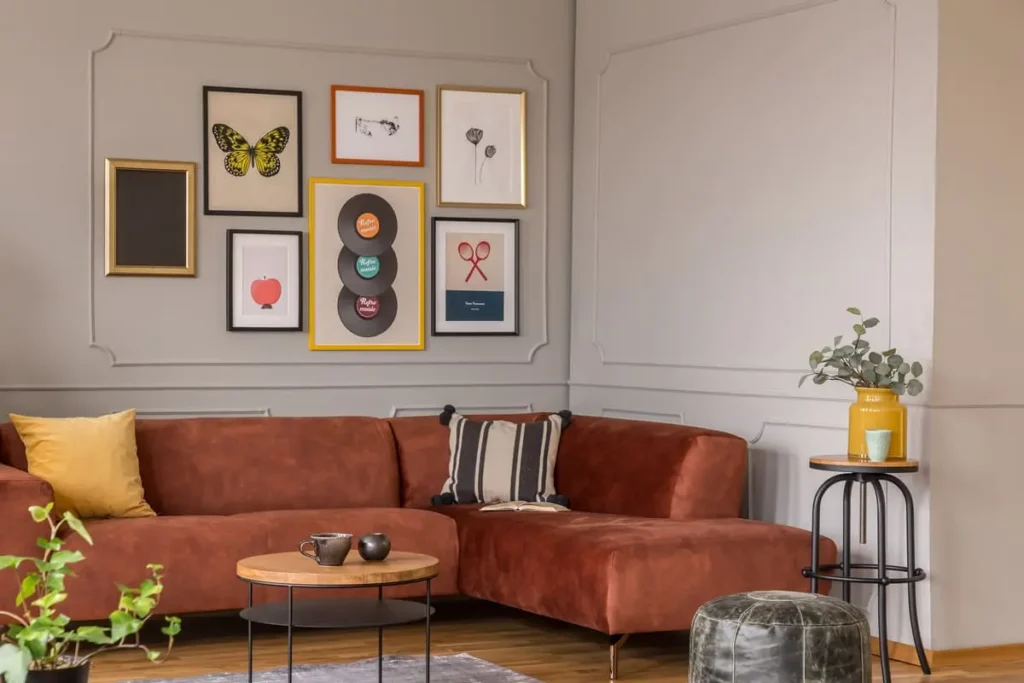
The most useful living room large wall decor ideas begin with the dimensions of your empty wall. You need enough visual weight to make the wall feel considered, whether that comes from one substantial object, a repeated arrangement, or the room’s architecture.
For broader large living room wall decor options, see our general eight-ideas guide. Here, we’re solving the specific problem of decorations getting lost.
How Big Should Wall Decor Be on a Large Wall?
Try for an art piece or composition that is approximately 60–75% of the usable wall’s width, taking measurements from the wall itself where there is no furniture beneath it.
This is a basic ratio based on width. Height will vary depending on the format of the art piece, architectural openings, and viewing angle. A high ceiling does not necessarily require an equally tall painting.
Measure the usable width between corners, doorways, windows, or other architectural boundaries and multiply it by 0.60 and 0.75.
| Usable wall width | Approximate artwork or composition width |
|---|---|
| 10 feet | 72–90 inches |
| 12 feet | 86–108 inches |
| 16 feet | 115–144 inches |
A twelve-foot entryway wall might therefore need a composition seven to nine feet wide. An ordinary framed print can struggle to hold that much space by itself.
When evaluating living room large wall decor ideas, the proposed outer edges should be marked using painter’s tape. Include frames and gaps within this area. If there is furniture beneath it, check whether the decoration works with its width as well as the wall’s dimensions.
5 Ways to Fill a Large Wall (Not Just Bigger Art)
Fill a large wall with one oversized artwork, repeated matching objects, substantial furniture, a full-wall architectural finish, or a tall plant.
These living room large wall decor ideas supply enough presence to register across the room. Choose the one that addresses your wall’s proportions before buying finishing touches.
1. Give one oversized piece enough room
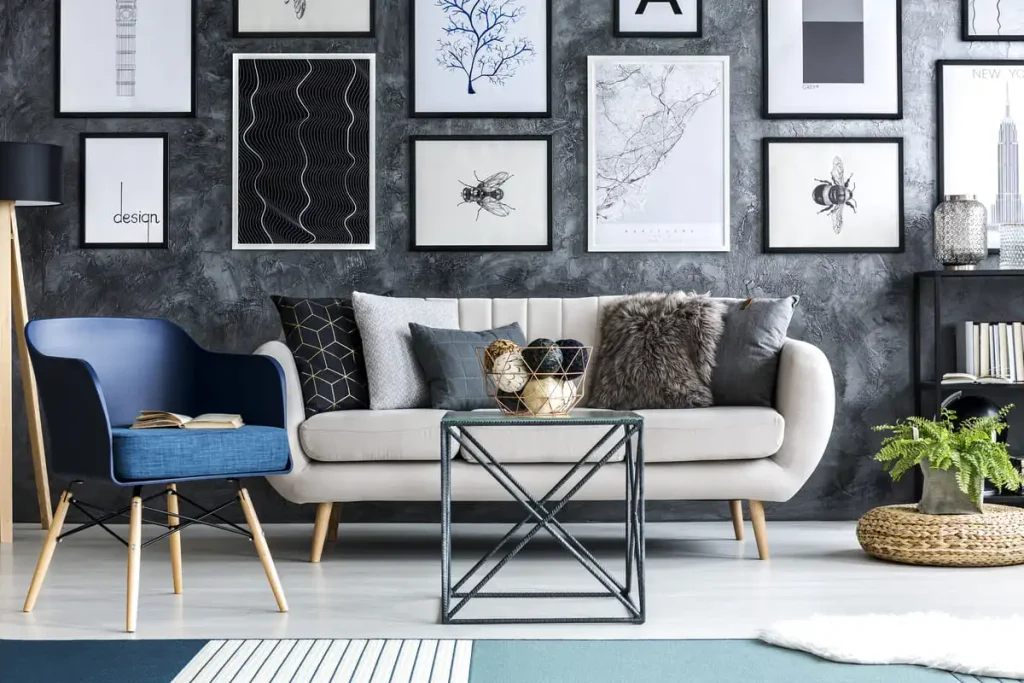
On an empty wall, select a painting or a framed picture that spans roughly 60–75% of the usable wall’s width. Look at its actual physical size; sometimes, a piece labeled “large” might not be big enough for your wall.
It is easier to perceive simple pictures at a distance. A landscape, an abstract, or a photograph with a clearly defined subject can be interesting without relying on small details.
Consider all the aspects related to delivery and installation before placing an order. This includes mounting and shipping costs.
2. Repeat identical objects as one composition
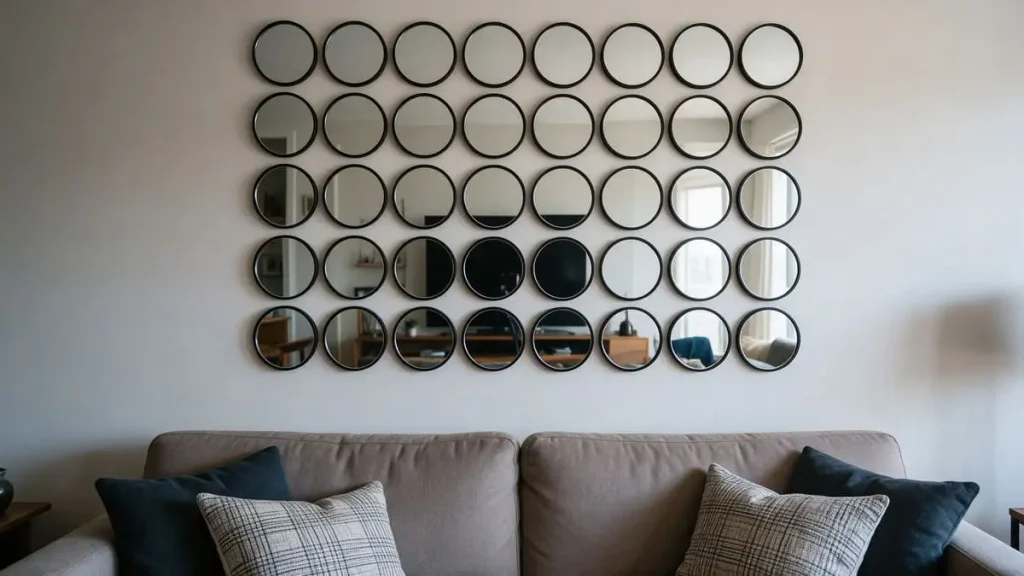
Just a few inexpensive mirrors, plates, or baskets that match one another can produce a large arrangement for less than a single custom-sized artwork. Repeating smaller pieces creates a consistent pattern; symmetrical groups help the pieces look like one set.
Begin with the width you require. Four 16-inch objects with three 3-inch spaces between them cover 73 inches. You can add rows to increase the height.
Decide on your desired shape and finish, and then use paper templates to plan the arrangement before hanging the objects. Widening the spaces too much separates the objects.
This approach makes large living room wall decor easier to assemble in stages. Compare the complete cost, including hangers, before assuming a collection will be cheaper.
3. Let substantial furniture anchor the wall
An oversized bookcase, armoire, or display case will help add some much-needed presence to the overly large wall as well as provide you with plenty of storage space. Carla Aston, an interior designer, places tall cabinets along with other pieces of furniture to compensate for overly large walls.
Consider the total dimensions of the piece – a narrow bookcase may not work on a wide wall, whereas an oversized armoire will make for a great focal point.
Place your furniture first and then evaluate the space left around it. The shape alone might do the trick. Keep the top of your furniture clear of any items and ensure the doors open freely. Install the anti-tipping kits recommended by the manufacturer.
4. Take architectural texture to the boundaries
Full-height wood paneling, a floor-to-ceiling wallpaper mural, or exposed or faux brick turns the wall itself into the focal point.
Scale comes from continuity. Extend the treatment to an architectural termination point such as a corner or the ceiling, so that it blends in with the rest of the space.
A mural tailored to the wall’s dimensions is particularly effective because the complete picture can be made to fit the wall. Graham & Brown distinguishes these whole-image murals from repeating wallpaper patterns. Make sure that the crop does not place the main focus of the picture where a doorway will interrupt it.
In a quiet space, choose wide panels or a limited materials palette.
5. Use a tall plant to occupy vertical space
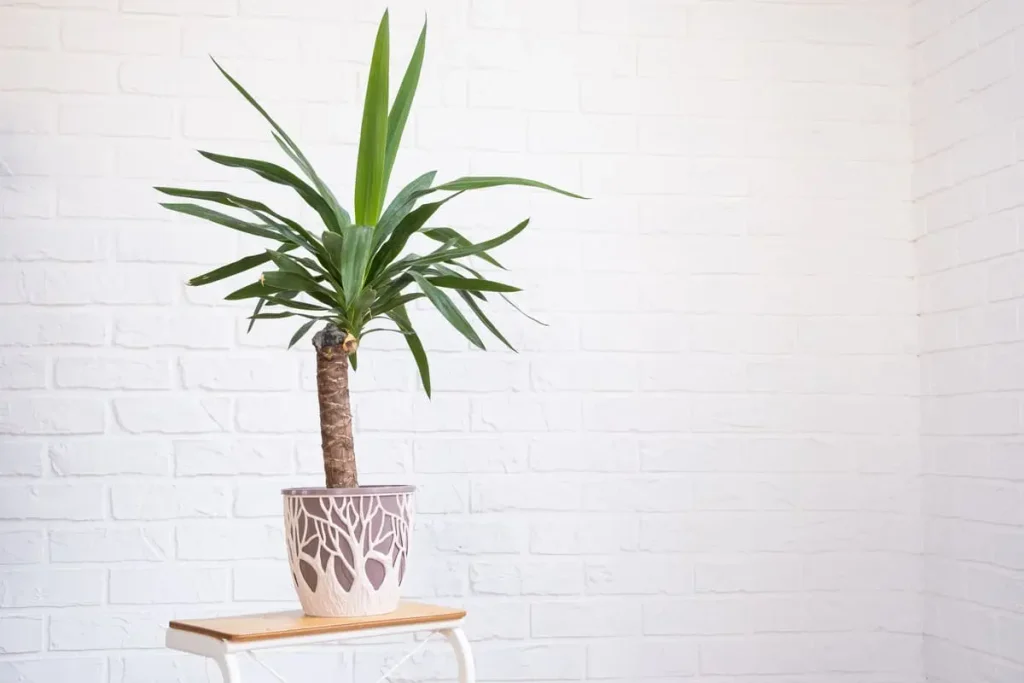
A plant that is six to eight feet tall will create a strong silhouette when placed in front of the wall, adding height, depth, and movement to a previously blank spot.
Check the spread of the plant along with its height. An upright plant is ideal for a narrow gap, while a plant with spreading foliage requires room next to the furniture.
Refer to our article Tall Indoor Plants for Low Light Corners for plants that may work in your space. Kentia palm is one such choice; it grows slowly and tolerates low light according to NC State Extension. Choose a plant suited to the existing light, and buy close to the size you need rather than relying on rapid growth in low light.
What If You Don’t Want to Decorate the Wall At All?
Leave the wall clear and give the room a stronger focal point through floor-to-ceiling drapery, an oversized light fixture, or existing exposed ceiling beams.
Some living room large wall decor ideas work by shifting attention elsewhere. A large curtain treatment along the blank wall would provide the necessary texture and scale for the room. If there are any windows, allow the material to extend beyond the windows onto the surrounding wall. A small curtain treatment would not make much impact.
Similarly, an oversize pendant would help define the seating area. Select an appropriate shape that has enough visual weight to be noticed in the room.
This solution is suitable for rooms whose height exceeds their width considerably. You can leave plenty of wall space empty as long as the room provides something to look at. Look at the view from the primary seating position; the blank wall should seem like a part of the whole room.
How Do You Decorate a Tall Wall Differently From a Wide One?
Break a tall wall’s height with a contrasting paint line or horizontal trim, while using a broader composition to address a wide wall.
For living room large wall decor ideas involving vaulted ceilings or stairwells, try establishing a lower visual boundary. On a tall wall, installing horizontal trim about eight or nine feet above the floor would be a good starting point. The height can be adjusted to suit windows, doors, and existing trim.
Paint the top part of the wall in a slightly darker color. Extending the same color onto the ceiling would give the impression of having a lower ceiling. As per the advice given by Paper Room, if you have a dark-colored ceiling, bringing that color down the wall to the picture rail would enhance the effect.
Measure out the area and try paint swatches both in daylight and evening lighting. The height of eight to nine feet is just a starting point; the actual installation height should suit the room.
How Do You Decorate the Wall Behind a TV?
Build an arrangement around the TV or define the section behind it with paint or wallpaper so the screen belongs to a larger composition.
For TV-focused living room large wall decor ideas, include the screen’s rectangle in your initial layout. Emily Henderson’s design team shows how surrounding artwork can be used to incorporate a TV into the room. Place paper templates on the wall on both sides of the screen, leaving enough open space to keep the viewing area from feeling crowded.
Alternatively, make a painted or wallpapered area that aligns with the media console below. A dark, low-sheen background will help diminish the contrast around a black screen; wallpaper will add some variety when the TV is off.
The best large living room wall decor around a screen has clear boundaries. Align the feature with the console or another architectural element, and keep cables tidy so stray lines do not interrupt the composition.
FAQ
Big walls can work with big artwork, groups of inexpensive matching items, or nothing at all hung on them; use what suits the size of the wall and your pocketbook.
Begin with about 60% to 75% of the usable wall’s width for an individual object or composition. If you are layering or grouping objects together, you may use less space provided that other visual elements such as furniture, depth, or texture provide additional visual heft.
What’s the cheapest way to fill a large wall?
The use of inexpensive matching mirrors, plates or baskets can be an economical choice at times. You need to plan the size they will occupy when arranged together and compare the price with the cost of one large print.
Do I have to hang anything on a really large wall?
No. Through contrasting paint, heavy drapes, and dramatic lighting, one can change the perceived proportions of the room without hanging artwork or other wall decorations.
How do I decorate a tall wall differently than a wide one?
Incorporate horizontal trim or a contrasting paint line to create breaks in height. Bringing down the ceiling color to this level will make the room seem more enclosed. Wide walls generally benefit from compositions that work horizontally.